Showing posts with label Art. Show all posts

Thursday, March 19, 2009

Eindhoven

On Friday we stopped in Eindhoven to explore a bit before catching a flight to Ireland. Our only image of the town came from the series Band of Brothers; it was one of the first towns liberated by the Allies in the Netherlands. The city was largely destroyed by air raids in WWII (including Allied bombing during Operation Market Garden). Unfortunately, the city was rebuilt in the sixties and is now largely a jumble of big, ugly concrete block buildings. Today the town is mostly industrial, with a quarter of its residents working in the technology and ICT field. Philips built its first light bulb factory here, but has since moved to Amsterdam in search of a larger workforce.We walked through the city center, filled with chain stores, a few McDonalds, a Burger King, and a KFC, on the way to the modern art museum. Our favorite exhibit at the Van Abbemuseum was by Dan Perjovschi. The exhibit was a room filled with simple drawings reflecting current political, economic, and culture headlines.

I'd like to say we will be back, but it's highly unlikely unless we have another flight to catch out of the Eindhoven Airport.

Sunday, March 8, 2009

The Girl with the Pearl Earring

Today we rode our bikes to Den Haag to the Mauritshuis Museum to see The Girl with the Pearl Earring. The bike ride was wonderful; the air was crisp and the sun was shining. Tulip like wildflowers were just starting to bloom up along side the canals and paths to Den Haag.

This trip was inspired by my earlier viewing of the movie and visiting the Vermeer Center in Delft. After learning about Vermeer's life in Delft and his superior skill in painting light, I knew I had to see the famous painting in person. The painting is magnificent. The audio guide calls her the Mona Lisa of the Netherlands, but I think the Mona Lisa is the Girl with the Pearl Earring of Italy. She just shines on the canvas; the light and luminosity is amazing.
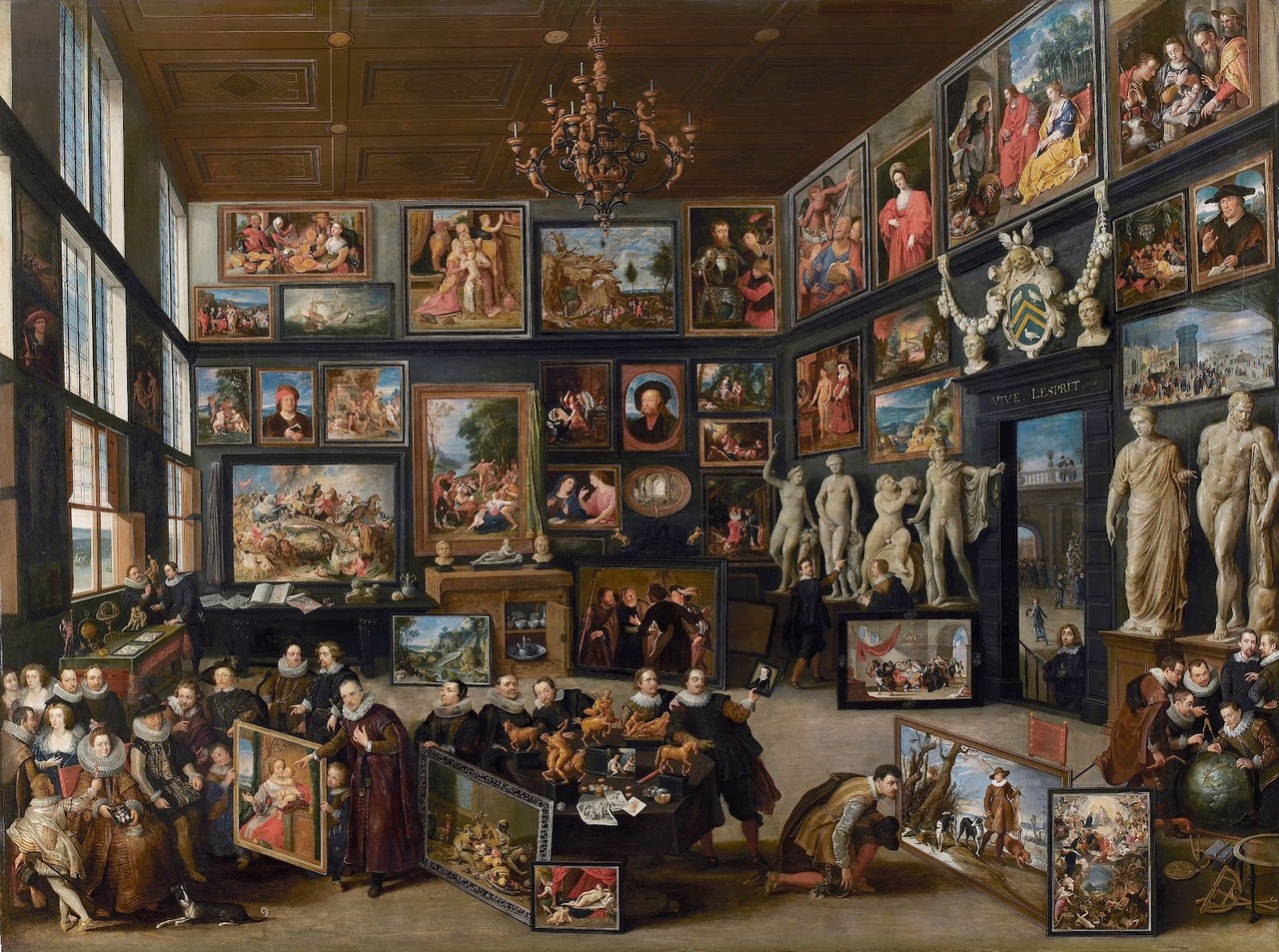
She may be the hallmark of the gallery, but the rest of the collection is quite impressive. The gallery houses two other paintings by Vermeer - a lovely landscape of Delft and one of his first works, Diana and her Nymphs. In addition, there are a dozen Rembrandts, a couple Ruebens and van Dyck (famous wedding portrait painters) and an interesting painting by Willem van Haecht. The painting, Apelles painting Campaspe, is a painting of hundreds of paintings - or an art gallery. The picture below isn't the same painting, but is done in the same style. The level of detail in the mini paintings was amazing - he had to be a master at many techniques.After we finished with the museum, we rode back to Delft enjoying the sunshine and flowers on the way.

Thursday, March 5, 2009

Vermeer

Since I had a few hours to kill, with Matt busy plugging away at models and simulations of page-long mathematical equations, I was looking around iTunes for a movie to rent and found Girl with the Pearl Earring (a fictional account of the Vermeer painting above) on sale for $.99. By pure coincidence, I had checked out the book Girl in Hyacinth Blue (a fictional tale of a long lost Vermeer painting) at the library a few days before. Since Delft is Vermeer's home town, I thought it was time I learned more about him and his work. We haven't made it to the museum in Den Haag yet that houses the painting, so I thought the movie and book would be a good introduction to Vermeer and his work.


While little is know about Vermeer's life and the subjects in his paintings, the movie weaves a believable tale. Every scene is captured with the light and color that are signatures of Vermeer's work. In addition to the beautiful masterpiece like scenes, the movie shows glimpses of what life was like in Delft in the 1600s.

After being intrigued by the movie, I took a trip to the Vermeer Center in Delft this morning. While the center does not have any of Vermeer's paintings, it is a worthwhile museum. The exhibit starts with a 5 minute introductory video of Delft around the time of Vermeer. It was quite fascinating to see how the places I walk by every week looked in the 1600s. Although the originals are housed elsewhere, the museum does have a life size print of each of Vermeer's confirmed works in chronological order with commentary. In addition, the museum explains how he mixed paint, which elements he used, his lighting techniques, and where he possibly learned his craft.

This weekend we will be going to Den Haag to the Mauritshuis to see some of Vermeer's paintings, including The Girl with Pearl Earring and the landscape View of Delft.

Sunday, March 1, 2009

Late Night @ The Van Gogh Museum

On any given day The Van Gogh Museum is stocked full of Van Gogh's bright, vivid paintings arranged in a wonderful chronological story of his life, however, currently the exhibit Van Gogh and the Colors of the Night brings a whole new set of gems to the museum. In collaboration with the MoMa, the museum has put together an extraordinary collection of Van Gogh's and his contemporaries' paintings of nighttime scenes - including the famous Starry Night.
We journeyed to Amsterdam to see this special exhibit during their weekly Friday nights at the museum event. While gazing at Van Gogh's amazing paintings, we were treated to the sounds of Jazz vocalist Fay Claasen.


Friday, February 27, 2009

Art In Situ


For the best art in Milan, get out of the galleries and head to the Il Cimitero Momumentale. The cemetery was created in 1870 and it still used today. The Italians do cemeteries just like they do life - over the top.

The tombstones, plaques, and family buildings are lavishly decorated with sculptures, candles, flowers, photos, and inscriptions. The art ranges from weeping angels to gruesome grim reapers to modern sculptures to scientific themes to Gothic arches to sculptures of the entire last supper scene.

Photography was frowned upon, so I could only snap a few shots with our little camera.

Tuesday, February 24, 2009

The Non-Fresco, Dan Brown Got Totally Wrong

I can think of a few works of art and a sampling of monuments that didn't quite live up to the expectations. When you have heard about a masterpiece, studied it in art history and history classes, and accumulated anticipation, sometimes you are going to be disappointed.

While Leonardo's leading lady can leave you wishing for more, his Last Supper leaves you fully amazed. I sprung for a guided tour for this visit - normally I avoid tours like the dog poop all over Europe's sidewalks. However, I did not have time to do all the research and create an audio tour for such a quick visit, so I happily shelled out the extra €3 for commentary and prayed cameras weren't allowed.


After proceeding through a series of humidity and pressure regulated rooms, we were suddenly face to face with Christ in Leonardo's masterpiece. The huge non-fresco (the guide was adamant that the Last Supper is NOT a fresco and this is the main reason it is so difficult to preserve) spanned the entire back wall, making it seem as if the room extended into the dining room of The Last Supper. The perspective and depth of the mural truly draws you into the painting and the emotion depicted on the disciples faces makes you feel as if you were there.

While the guide pointed out each of the apostles and explained their role in the story, I tried to determine if it really was John or Mary Magdalene. My thoughts were suddenly interrupted by her passionate explanation of why Dan Brown got it all wrong. She asked us that if we took nothing else from her talk to take this: John, being the youngest disciple, was historically portrayed with a feminine face to show his youth. No conspiracy, no hidden tales, just misinterpreted historical symbolism.

If the mural alone did not impress you with Leonardo's genius, you only had to turn around to compare it to a mural painted on the back wall by a contemporary of his. There was no comparison to be made. Well except that since the back mural was an actual fresco, the colors had retained their brilliance and intensity.

More pictures of the Church of Santa Maria delle Grazie can be found here.

Tuesday, January 20, 2009

Art

"The art galleries of Paris contain the finest collection of frames I ever saw."
-Humphrey Davy

And if the frames are fine, the ceilings are magnificent. And if the ceilings are magnificent, the art is breathtaking.

Okay, well most of it and more if it would be if there weren't tons of tourists standing in the way snapping pictures. Seriously, stop taking terrible photos and actually look at the art. I am of the opinion they should ban cameras in museums - the pictures are terrible, the takers are distracting, the crowds clog the flow of traffic, and I don't want to be in your photos. Let me let you in on a little secret - your face in front of a masterpiece does not enhance it. Buy a postcard from the gift shop, buy the collection catalog, look the piece up on wikipedia or the museum websites, savor your memories, but please, please stop taking worthless pictures of priceless pieces. And OMG if you are taking the picture with your cell phone...did you wake up this morning and find yourself mysteriously in Paris?

Getting down off my soapbox...
I think the Louvre is more quantity than quality, but we did visit our three favorite ladies: Venus de Milo, Winged Victory, and Mona Lisa. (See how I did that - I shared the art with you without taking ridiculously awful pictures you didn't want to see anyway at the museum while obstructing the view of countless other visitors.)

Next we walked across the courtyard to the Decorative Arts Museum and saw the evolution of design from Art Nouveau to the 21st Century. I especially enjoyed the exhibit on the color red in design.

Then it was through the Tuileries Gardens to my favorite museum in Paris (or anywhere else for that matter).


A museum chosen and designed by Monet to display his paintings "without borders". The museum has two oval rooms, each of which house 4 canvases that spread around the room allowing for a 360 degree view of the Nympheas (or waterlilies paintings). You can virtually visit the museum here. However, I must warn you, viewing these paintings will make you want to buy a plane ticket to Paris immediately. Go ahead and do it; I will meet you there and we can gaze at these magnificent paintings together!

Needing to get the most out of our museum pass, we popped into the Cluny Museum to peek at the Lady and the Unicorn tapestries. They were beautiful and amazingly well preserved.

Our time in Paris was coming to an end. We visited my favorite bakery Eric Kayser and picked up a few loaves of olive bread for our train picnic. We completed our picnic with the leftover cheeses from the day before and a bottle of French wine. What a lovely way to travel!

Au revoir Paris!

Dawn til Way Past Dusk

Mom and I were in Paris for only 2 and half days, so we had to make the most of the 54 hours. Day two started beautifully - literally - with a gorgeous sunrise and magnificent rainbow.
After picking up croissants from Hilaire ( "where the hotels buy their croissants" according to Rick Steves), we headed to mass at the Notre Dame.
It was nice to be able to walk through the church and appreciate the sheer size of the cathedral before the hoards of tourists descended upon it just hours later. Although, I do have to say the "modernish" nativity did surprise me and felt quite out of place in the medieval building.Yes, there is a flat screen and floating lights in the nativity at the Notre Dame. It had the same tacky effect that a flat screen fire place does in living room; you just wonder, "Why?"

Next we walked down the Seine River to the Orsay Museum, my now second favorite art museum. The building was just as grand and magnificent as I remembered and the paintings even more beautiful. My favorite part of the museum (like most people's, I'm sure) is the impressionist paintings. I love the Monets of the women with the umbrella in the fields and Degas' ballerinas.There was also a temporary exhibit exploring the connection between the Le déjeuner sur l'herbe by Edouard Manet and a series of paintings and sculptures by Pablo Picasso. It displayed the original painting by Manet surrounded by works by Picasso that were inspired by the painting. I found it amazing that one painting could inspire an entire series of work by Picasso.

After the museum we started a walking tour of the historic core of Paris, which included the Ill de la Cite and the Ill St. Louis - the two islands in the center of the Seine River. We began by walking past the booksellers along the river; unfortunately many of them were closed due to the dreary weather.

Along the first part of the walk we visited Pont Neuf, the Latin Quarter, the Concierge (which had a very nice architecture exhibit on Paris' past world exhibitions), and ended up at the Sainte-Chapelle. The chapel, built for Louis IX, is an amazing display of stained-glass windows, tiled floors, and painted walls. The upper chapel is truly breath taking (even the second time).
Next we returned to the Notre Dame to visit the archeological museum under the cathedral and climb the towers to see our favorite gargoyles.
Continuing on to the Ill St.Louis, we picked up a picnic lunch from the cheese shop and bakery. Unfortunately, due to the rain we ate our picnic under the awning of a closed shop. Then we browsed through the shops and boutiques lining the streets of the island, including my favorite kitchen stores that sells goods made by Pylones. We ended the walk with some ice cream (and coffee - our day was far from over) from Berthillon.

Friday, January 9, 2009

Late at Tate Britain

We ended the day Friday by attending Late at Tate Britain. We started the evening by grabbing a glass of wine and watching a multimedia presentation by Savage Messiah on alternative visions of urban London. Then we wandered through a room bursting with electro pop by duo Petit Mal.

Eventually we found our way to the Manton Studio and watched a loop of contemporary Romanian short films. Our favorite by far was "The Yellow Smiley Face" by Constantin Popescu. It was a sketch about a set of parents trying to log-on to Yahoo Messenger to chat with their son in America. Hilarious. If you ever have a chance to watch it you should; it is a very comical film showing "digital imigrants".

After catching the entire loop of movies, we headed down to the cafe to grab some dinner. We generally do not eat in museum restuarants because we find them expensive and not very good; however, we found ourselves eating in quite a few of the British musuems (maybe because they are all mammoth in size and take days to go through) and were quite pleasently surprised by the prices and quality. This meal is only important in mentioning because I had tea and a scone. The "homemade" scone was delicous and made even more so by the fact that it was served with clotted cream and jam. Ahhhh, I now felt like I had had a proper English tea.

Thursday, January 8, 2009

National Portrait Gallery

Knowing we didn't have time to explore the HUGE National Gallery, we headed around the corner to the National Portrait Gallery to see some famous faces. The gallery was filled with famous faces from the past and present.

My favorite portraits were in a temporary exhibit by Anderson & Low called Champions. The room was filled with photographs of famous athletes - nude. They were nude to show that despite their fame and bodily perfection, they are just as susceptible to HIV/AIDS as everyone else. The photographs really show off their stunning strength and beauty. The collection was commissioned to benefits the Elton John AIDS Foundation.

London is hosting the 2012 Summer Olympic Games and the National Portrait Gallery has dedicated a few rooms to portraits of British Olympic athletes. Here you can watch a video of David Beckham sleeping by Sam Taylor-Wood. One of the most interesting portraits is of the swimmer Duncan Goodhew by Marty St. James. It is a collection of video screens that shows the swimmer diving into the pool and swimming from every conceivable angle. I am sure Goodhew got the best stroke analysis of his life from the film.

Matt also enjoyed checking out the portraits of famous scientists, like William Kelvin and Michael Faraday, while I was enjoying the portraits of Princess Margaret.

Tuesday, January 6, 2009

Tate Modern

After ducking out of the parade, we popped over to the Tate Modern to see artwork from the 20th century. Since modern art really isn't our thing (the Tate Modern was one of the only things open on New Year's Day in the area we were in), we decided to take one of the free introductory tours. Our tour took us through the Idea and Object wing and focused on the artists Martin Creed and Carl Andre. It was a nice look into minimalist art and helped us understand the thoughts and ideas behind it. On the way out we poked our heads into the Materials Gestures exhibit to see one of Monet's beautiful paintings, Water-Lilies.

Wednesday, December 3, 2008

Art Nouveau & Comics

Brussels is home to two often forgotten arts: Art Nouveau and comics.

Brussels is the capital of Art Nouveau, with the first two Art Nouveau buildings being built here in 1893 by Victor Horta and Paul Hanker. The movement of Art Nouveau, the merging of applied art and fine art, sought to combine function and art into every part of life: architecture, furniture, textiles, household appliances, art, etc. It is recognizable by the curved lines, stained-glass windows, flora motifs, and metal & glass structures. My favorite characteristic of Art Nouveau are the Tiffany like stained-glass windows, made famous by Louis Comfort Tiffany, in so many of the buildings in Brussels.
We visited the Old England building- a classic example of Art Nouveau architecture- which houses the Musical Instrument Museum. Even though there are over 1200 Art Nouveau building in Brussels very few of them offer the public an opportunity to see the interiors and the Old England building provides one of these rare glimpses into the inside of the unique buildings - making a visit to museum worthwhile just to see the inside. While there was very little information provided in the museum in English, the music on display speaks internationally. I particularly enjoyed the room where you could play and experiment with different musical instruments.


One of the most famous Art Nouveau buildings is the Waucquez Textile Shop, designed by Victor Horta and part of a four building group that has been declared a UNESCO World Heritage Site. Today the building is the home of the Belgian Comic Strip Center. Don't let the English website fool you - all the comics and almost all of the commentary is in French or Dutch. Do as Rick Steves recommends - visit the lobby, take photos with the comic book characters, and save your €5 entry fee to buy a beer later.


Brussels' love affair with comics doesn't end with the museum, or even the countless comic book shops around the city. They took it to a whole new level. There are 35 + sites throughout city where you can find larger than life comic character statues and murals - and more are added every year. We visited as many of them as made sense with our other site seeing - hopefully we will be back in Brussels before this adventure is over the see the rest, or at least add to our list.


Friday, November 28, 2008

A Low Country Blog

Since I have started my Educational Technology Ed.S. degree, I have been reading a lot of blogs. For me it seems to be one of the best sources of information on what is going on with technology and the classroom and gives me countless ideas and resources for that day when I FINALLY get my own classroom.

My travels through blogs as has led me to an interesting one on art and society in the low country. As I am sure most of you do, when I hear the term "Low County" I immediately think of the coastal region of South Carolina. However, here the "Low County" refers to the Netherlands and the Flemish region of Belgium.

I think The Low Countries is a wonderful blog to find out what is new and going on in the art world. For example, the Van Gogh Museum in Amsterdam is hosting Van Gogh and the Colors of the Night with the MoMA that will bring Starry Night to the museum in February. Don't worry, I have already bought my ticket...

Tuesday, November 18, 2008

A Second Chance

There have been modern art museums in many of the cities we have visited, but frankly after the Pompidou Center experience we have been turned off modern art. However, since we had already paid for it and they had a few Andy Warhol pieces, we decided to visit Museum Ludwig.

The museum had a wonderful temporary exhibit of Gerhard Richter's work, the artist that designed the new stain-glass window in the Dom. In addition to the huge pieces of abstract work, they had a collection of 100, paired painted glasses pieces that were gorgeous. I would love to have one of those in my home.

In addition, the museum had a neat audio exhibit from Paul Plamper called A Radio Play in Space. It was a room filled with tables; on each tables was 2-5 speakers (symbolizing the number of people sitting at the table) and 2-5 chairs. When you entered the room you were greeted with the ambient noise of a restaurant; you could sit down at any of the tables and listen to the conversation. Then something happens; sometimes inside the restaurant, sometimes outside the restaurant and a collective hush falls over the room. It is social experiment in whether people will become involved in the event or become distant.

Other highlights of the museum included:
  • 20th century American Pop Art
  • A temporary exhibit for filmmaker Jonas Mekas
  • A wonderful graphic design exhibit of Thomas Bayrle
  • An exhibit titled "Looking for Mushrooms, Beat Poets, Hippies, Funk,and Minimal Art: Art and counter cultural in San Fransisco around 1968"
Maybe the art wasn't so modern, maybe it wasn't so out there, but we definitely enjoyed Museum Ludwig. So much so that we might venture into a modern art museum in the city we visit.

Monday, November 17, 2008

Two of a Kind

Koln has museum card for €20.50 for two adults and two children, for which you can get into all the city museums (10+ museums) and use the local transportation. Since we had already forked over the cash, we tried to visit as many of the museums as possible.

After the Roman museum, we visted the Wallraf-Richartz Museum - the local art museum. While it had a smattering of Van Goghs, Monets, and Reniors - the best part of the museum was its temporary exhibit: Kunstler Paare or Artist Couples. The exhibit show the works of artist couples side by side and showed how their work influenced each other. While many know about the relationship between Frida Kahlo and Diego Rivera, it also explored lesser know couples like Lee Krasner and Jackson Pollock, Sophie Taeuber-Arp and Hans Arp, and Georgia O'Keeffe and Alfred Stieglitz. For many of the couples, it was clear how they influenced each other - some made parallel works, some worked together on pieces, and some adopted each others' style. The exhibit was fascinating - great art, wonderful text, and exquisite curation.

When in Rome...

Side Portal of the Original City Gate, 50AD

Well, not exactly Rome, but rather a city built in Roman times. The main street through Koln dates back 2000 years and the city was officially recognized by the Roman Empire in 50AD (AKA - made apart of the Roman Empire).

To explore its Roman routes we visited the Roman-Germanic Museum. The highlights of the museum were a mosaic floor from a Roman merchant's house the museum was actually built around and the original arch from the city gate. Apparently if you are important enough, like one of the leaders of the G8 countries, you can enjoy a meal in the museum in the mosaic floor room. We ate our sandwiches outside, under the arch - way cooler! Mosaic FloorRoman Bust

Monday, October 6, 2008

Step inside a Piet Mondian Painting...

Step inside a Piet Mondrian painting and enter the Rietveld Schroder House, a house built entirely in the "De Stijl" style or neoplasticism. Artists of this movement aimed to simplify everything to vertical and horizontal lines and used only primary colors along with white, black, and grey. The house provides a large contrast with the traditional style Dutch canal homes with which it shares a wall.

The house was designed by Gerritt Rietveld and Truus Schroder. The owner of the house, Truus Schroder, is considered one of the architects because the house is a collaboration between the two - his artistic style and her functional designs. It was built in 1924 and was lived in by Ms. Schroder until her death in 1985.


The house was architecturally and artistically amazing. The furniture inside was even designed by the architects and follows in the De Stijl style. The house was designed with walls that could be removed during the day to allow for a more social, open atmosphere in the house. So at night there are 3 bedrooms and an office, but during the day the walls all slide back (much like a temporary classroom) and a large living space is created. I wish I could show you more pictures of the interior of the house, but it is protected by copyright and we were not allowed to take photos. A small clip of the house is available here.

This house is a world heritage site, considered "a masterpiece of human creative ability" and "an important and unique icon of western architectural history" by UNESCO. There are 7 UNESCO sites in the Netherlands (only 6 on the mainland - the 7th is in Curacao) and we hope to visit them all during our stay here. In comparison, the United States only has 20 sites.

Different Art

Everyone loves a Van Gogh. A Monet will always leave you breathless. The Mona Lisa inspires every art lover. The Venus de Milo will forever be a masterpiece.

But sometimes you want something different.

The Aboriginal Art Museum in Utrecht was a wonderful break from usual art museum proceeding from ancient classics through realism, touching off in impressionism with a finish in modernism. If you ever yourself southeast of Amsterdam, take a trip to see the paintings inspired by land.

I loved the bold designs made of thick lines and dots in earth tone colors. The exhibit changes 4 times a year, so every visit holds a new look at the art, the artists, and their relationship to the land and culture. The exhibit we saw featured the nomadic lifestyle and contrasted the Aboriginal art and artists with a Belgium nomadic artist and his works.

Sunday, October 5, 2008

A Home for Miffy


Miffy, the star of over 30 children's books, is a simple white rabbit created by Dick Bruna. The books have been translated in over 40 languages, making Dick Bruna the second most read children's author (behind Roald Dahl).

Bruna's hometown, Utrecht, has created the Dick Bruna Huis as a home for Miffy and other works. He was a graphic artist that designed book covers for other authors, most notably the Black Bear and Simenon's Maigret series, and posters for various organizations and businesses. Dick Bruna's work is distinguished by simple lines and bright colors. He takes the three-dimensional world and turns it into a flat page. His straightforward and simple work turns basic shapes and primary colors into icons.

The museum was wonderfully put together, with works hanging at two heights - one for adults and one for children. It was was truly a multimedia experience; you could listen to his books, watch movies of him creating his books, admire his art, use the computer to learn about his life and art, and, of course, play in a child's size Miffy house.

Best of all, Inge got a new bell starring Miffy and her bicycle!

Tuesday, September 23, 2008

Versailles - Still Avant Garde

As you step into the Chateau de Versailles you expect to see the regal wonder that was avant-garde in its day, with its decadent decor, endless rooms, and beautiful art. It will not disappoint you - until you catch a glimpse of the reflective mylar balloon dog holding court in the center of the Salon of Hercules. Startled, you blink and hope that when you open your eyes again the atrocity will be but just a dream. But, no. There it is a 10 ft tall, fushia balloon dog. You begin to wonder - Is it someone's birthday? It this a joke? Are you having a nightmare?

No, no, no. It is the latest art exhibit on display at the Chateau. Straight to Versailles from New York, New York, it's Jeff Koons. It's art that blends in seamlessly with the elegant rooms at Versailles; art that is harmony with its surroundings; art that adds to the exquisite decor of the Chateau.


Apparently, one of the chandeliers got misplaced from this room - for in its place a lobster is hanging instead.

I am sure the servants working in Versailles would have loved to have had 6 vacuum cleaners at their disposal. Unfortunately, the vacuum cleaner was not invented until 1868 by Ives W. McGaffney; therefore, I think we should remove all vacuum cleaners from Versailles.


While they might have believed in mermaids during the times of Louis XIV, I am not sure if the Pink Panther and Jacques Clouseau had made their debut. Although Jacques Clouseau is French - now I definitely see the connection.

Someone must be having a birthday party in the Hall of Mirrors - how lovely.

Well at least the gold on the statue fits into the decor at Versailles - not so sure about Micheal Jackson and Bubbles.

Oh you know where the inspiration for these turtles came from...

Your childhood video games!


The art even made its way to gardens, the lovely formal gardens of Versailles.

Now, don't get me wrong. I think these pieces of art are nice, even avant garde - perhaps stunning.  It's just that I would have appreciated them (and Versailles) more if they had found a home in the George Pompidou Center, an art museum that has an appreciation for the more modern of art, such as blank white canvases and sculptures made out yesterday's trash.

Oh what I wouldn't give to sit down and have coffee with the curator of this exhibit...