Showing posts with label Museum. Show all posts

Thursday, March 19, 2009

Eindhoven

On Friday we stopped in Eindhoven to explore a bit before catching a flight to Ireland. Our only image of the town came from the series Band of Brothers; it was one of the first towns liberated by the Allies in the Netherlands. The city was largely destroyed by air raids in WWII (including Allied bombing during Operation Market Garden). Unfortunately, the city was rebuilt in the sixties and is now largely a jumble of big, ugly concrete block buildings. Today the town is mostly industrial, with a quarter of its residents working in the technology and ICT field. Philips built its first light bulb factory here, but has since moved to Amsterdam in search of a larger workforce.We walked through the city center, filled with chain stores, a few McDonalds, a Burger King, and a KFC, on the way to the modern art museum. Our favorite exhibit at the Van Abbemuseum was by Dan Perjovschi. The exhibit was a room filled with simple drawings reflecting current political, economic, and culture headlines.

I'd like to say we will be back, but it's highly unlikely unless we have another flight to catch out of the Eindhoven Airport.

Sunday, March 8, 2009

The Girl with the Pearl Earring

Today we rode our bikes to Den Haag to the Mauritshuis Museum to see The Girl with the Pearl Earring. The bike ride was wonderful; the air was crisp and the sun was shining. Tulip like wildflowers were just starting to bloom up along side the canals and paths to Den Haag.

This trip was inspired by my earlier viewing of the movie and visiting the Vermeer Center in Delft. After learning about Vermeer's life in Delft and his superior skill in painting light, I knew I had to see the famous painting in person. The painting is magnificent. The audio guide calls her the Mona Lisa of the Netherlands, but I think the Mona Lisa is the Girl with the Pearl Earring of Italy. She just shines on the canvas; the light and luminosity is amazing.
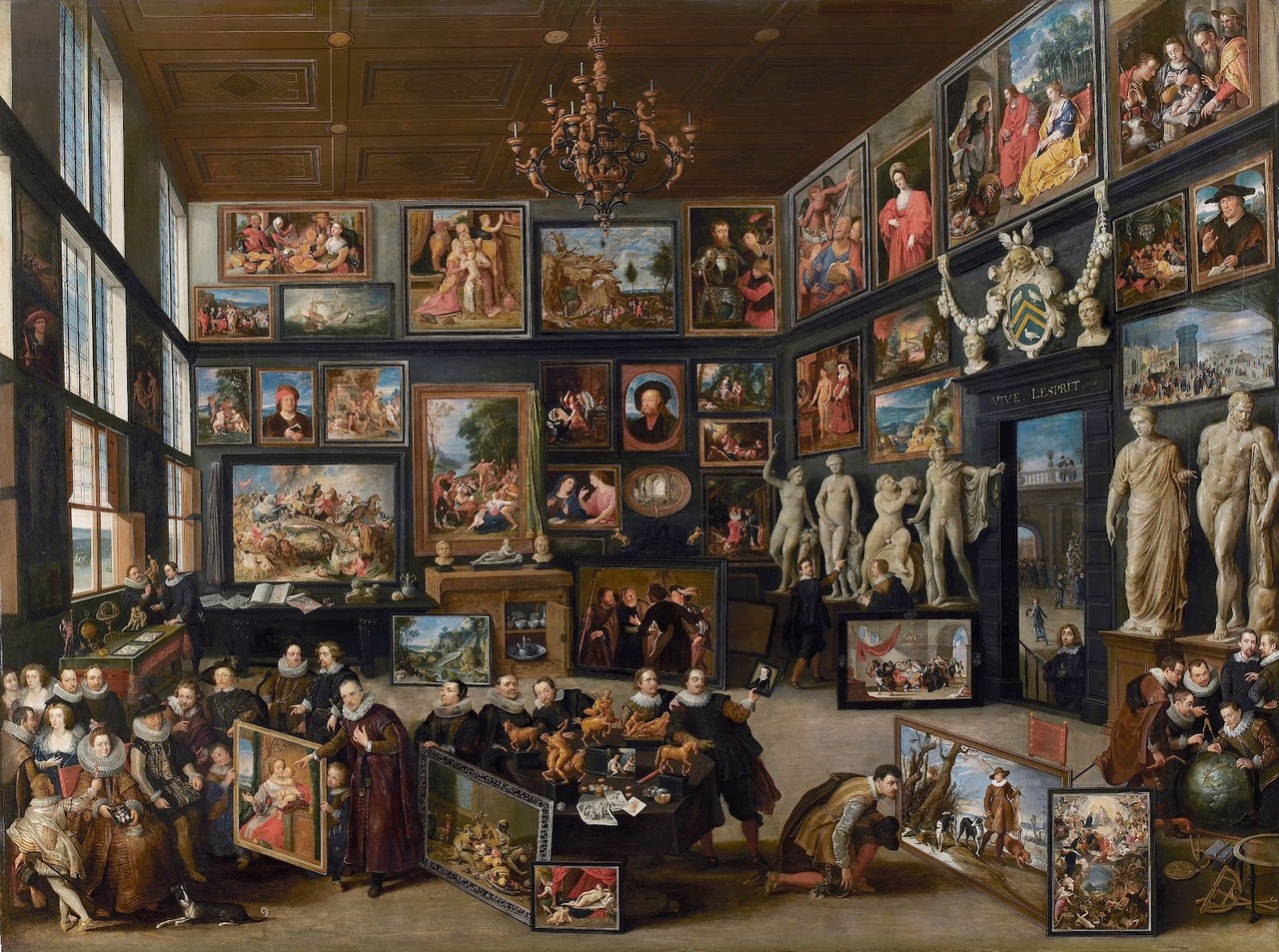
She may be the hallmark of the gallery, but the rest of the collection is quite impressive. The gallery houses two other paintings by Vermeer - a lovely landscape of Delft and one of his first works, Diana and her Nymphs. In addition, there are a dozen Rembrandts, a couple Ruebens and van Dyck (famous wedding portrait painters) and an interesting painting by Willem van Haecht. The painting, Apelles painting Campaspe, is a painting of hundreds of paintings - or an art gallery. The picture below isn't the same painting, but is done in the same style. The level of detail in the mini paintings was amazing - he had to be a master at many techniques.After we finished with the museum, we rode back to Delft enjoying the sunshine and flowers on the way.

Sunday, March 1, 2009

Late Night @ The Van Gogh Museum

On any given day The Van Gogh Museum is stocked full of Van Gogh's bright, vivid paintings arranged in a wonderful chronological story of his life, however, currently the exhibit Van Gogh and the Colors of the Night brings a whole new set of gems to the museum. In collaboration with the MoMa, the museum has put together an extraordinary collection of Van Gogh's and his contemporaries' paintings of nighttime scenes - including the famous Starry Night.
We journeyed to Amsterdam to see this special exhibit during their weekly Friday nights at the museum event. While gazing at Van Gogh's amazing paintings, we were treated to the sounds of Jazz vocalist Fay Claasen.


Tuesday, January 20, 2009

Art

"The art galleries of Paris contain the finest collection of frames I ever saw."
-Humphrey Davy

And if the frames are fine, the ceilings are magnificent. And if the ceilings are magnificent, the art is breathtaking.

Okay, well most of it and more if it would be if there weren't tons of tourists standing in the way snapping pictures. Seriously, stop taking terrible photos and actually look at the art. I am of the opinion they should ban cameras in museums - the pictures are terrible, the takers are distracting, the crowds clog the flow of traffic, and I don't want to be in your photos. Let me let you in on a little secret - your face in front of a masterpiece does not enhance it. Buy a postcard from the gift shop, buy the collection catalog, look the piece up on wikipedia or the museum websites, savor your memories, but please, please stop taking worthless pictures of priceless pieces. And OMG if you are taking the picture with your cell phone...did you wake up this morning and find yourself mysteriously in Paris?

Getting down off my soapbox...
I think the Louvre is more quantity than quality, but we did visit our three favorite ladies: Venus de Milo, Winged Victory, and Mona Lisa. (See how I did that - I shared the art with you without taking ridiculously awful pictures you didn't want to see anyway at the museum while obstructing the view of countless other visitors.)

Next we walked across the courtyard to the Decorative Arts Museum and saw the evolution of design from Art Nouveau to the 21st Century. I especially enjoyed the exhibit on the color red in design.

Then it was through the Tuileries Gardens to my favorite museum in Paris (or anywhere else for that matter).


A museum chosen and designed by Monet to display his paintings "without borders". The museum has two oval rooms, each of which house 4 canvases that spread around the room allowing for a 360 degree view of the Nympheas (or waterlilies paintings). You can virtually visit the museum here. However, I must warn you, viewing these paintings will make you want to buy a plane ticket to Paris immediately. Go ahead and do it; I will meet you there and we can gaze at these magnificent paintings together!

Needing to get the most out of our museum pass, we popped into the Cluny Museum to peek at the Lady and the Unicorn tapestries. They were beautiful and amazingly well preserved.

Our time in Paris was coming to an end. We visited my favorite bakery Eric Kayser and picked up a few loaves of olive bread for our train picnic. We completed our picnic with the leftover cheeses from the day before and a bottle of French wine. What a lovely way to travel!

Au revoir Paris!

Friday, January 9, 2009

Late at Tate Britain

We ended the day Friday by attending Late at Tate Britain. We started the evening by grabbing a glass of wine and watching a multimedia presentation by Savage Messiah on alternative visions of urban London. Then we wandered through a room bursting with electro pop by duo Petit Mal.

Eventually we found our way to the Manton Studio and watched a loop of contemporary Romanian short films. Our favorite by far was "The Yellow Smiley Face" by Constantin Popescu. It was a sketch about a set of parents trying to log-on to Yahoo Messenger to chat with their son in America. Hilarious. If you ever have a chance to watch it you should; it is a very comical film showing "digital imigrants".

After catching the entire loop of movies, we headed down to the cafe to grab some dinner. We generally do not eat in museum restuarants because we find them expensive and not very good; however, we found ourselves eating in quite a few of the British musuems (maybe because they are all mammoth in size and take days to go through) and were quite pleasently surprised by the prices and quality. This meal is only important in mentioning because I had tea and a scone. The "homemade" scone was delicous and made even more so by the fact that it was served with clotted cream and jam. Ahhhh, I now felt like I had had a proper English tea.

Thursday, January 8, 2009

National Portrait Gallery

Knowing we didn't have time to explore the HUGE National Gallery, we headed around the corner to the National Portrait Gallery to see some famous faces. The gallery was filled with famous faces from the past and present.

My favorite portraits were in a temporary exhibit by Anderson & Low called Champions. The room was filled with photographs of famous athletes - nude. They were nude to show that despite their fame and bodily perfection, they are just as susceptible to HIV/AIDS as everyone else. The photographs really show off their stunning strength and beauty. The collection was commissioned to benefits the Elton John AIDS Foundation.

London is hosting the 2012 Summer Olympic Games and the National Portrait Gallery has dedicated a few rooms to portraits of British Olympic athletes. Here you can watch a video of David Beckham sleeping by Sam Taylor-Wood. One of the most interesting portraits is of the swimmer Duncan Goodhew by Marty St. James. It is a collection of video screens that shows the swimmer diving into the pool and swimming from every conceivable angle. I am sure Goodhew got the best stroke analysis of his life from the film.

Matt also enjoyed checking out the portraits of famous scientists, like William Kelvin and Michael Faraday, while I was enjoying the portraits of Princess Margaret.

Monday, January 5, 2009

Natural History Museum

On Wednesday we went to the Natural History Museum. I was tremendously excited about this visit, partly because I recently read Bill Bryson's A Short History of Everything - a most accessible and fun book on natural history - which contained the following passage about the Natural History Museum in London:

The Natural History Museum contains some seventy million objects from every realm of life and every corner of the planet, with another hundred thousand or so added to the collections each year, but it is really only behind the scenes that you get a sense of what a treasure house this is. In cupboards and cabinets and long rooms full of close-packed shelves are kept tens of thousands of pickled animals in bottles, millions of insects pinned to squares of card, drawers of shiny molluscs, bones of dinosaurs, skulls of early humans, endless folders of neatly pressed plants. ... The spirit room alone holds 15 miles of shelving containing jar upon jar of animals preserved in methylated spirit.

Back here are specimens collected by Joseph Banks in Australia, Alexander von Humboldt in Amazonia, and Darwin on the Beagle voyage - and much else that is either very rare or historically important or both.

How can that not capture your imagination? Just think of all the rare artifacts at the museum that have passed through the hands of exceptionally brainy people and all the knowledge that has been extracted. Think of the vast extent of the British Empire and their unique position to form an expansive collection for all their museums, including the Natural History Museum.
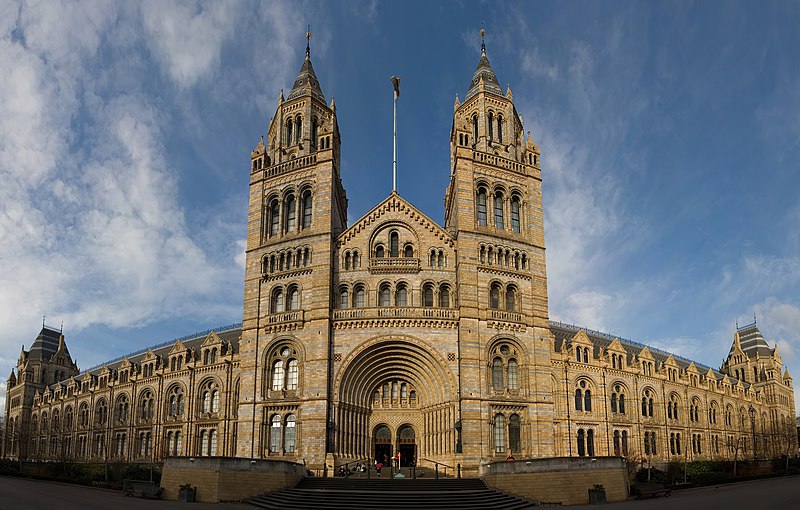


At the museum, we first attended their temporary Darwin exhibition (another link), which was wonderful. It told the tale of Charles Darwin's life, from his invitation to join the HMS Beagle on a voyage around the world as its naturalist, to his aha! moment stemming largely from observations on the Galapagos Islands, to the years after he finally published his theory of evolution through natural selection in On the Origin of Species in 1859.

I have two favorite anecdotes about Darwin from the exhibit. The first was that he liked to "sample" (cook and eat) many of the animals he encountered on his travels. The second anecdote is from an encounter he had with gauchos in South America, who took him hunting for lesser rheas. The gauchos hunted rheas using bolas (two balls attached with a cord). When Darwin tried, he got his bola wrapped around the legs of his own horse. He wrote in a letter, "The Gauchos roared with laughter; they cried they had seen every sort of animal caught, but had never before seen a man caught by himself."

If you haven't been to the UK (or visited since 2000), you might also be interested to know that Darwin's likeness now adorns the £10 note.
Matt riding the escalator through Planet Earth to the Volcano Exhibit
As for the rest of the museum, we looked at the exhibits on birds, dinosaurs, primates, geophysics, and minerals. We also visited The Vault, a display of rare (and often historically interesting) specimens of "gems, crystals, metals, and meteorites." The museum was great and I hope one day I can go back and spend more time there.

Wednesday, December 3, 2008

Art Nouveau & Comics

Brussels is home to two often forgotten arts: Art Nouveau and comics.

Brussels is the capital of Art Nouveau, with the first two Art Nouveau buildings being built here in 1893 by Victor Horta and Paul Hanker. The movement of Art Nouveau, the merging of applied art and fine art, sought to combine function and art into every part of life: architecture, furniture, textiles, household appliances, art, etc. It is recognizable by the curved lines, stained-glass windows, flora motifs, and metal & glass structures. My favorite characteristic of Art Nouveau are the Tiffany like stained-glass windows, made famous by Louis Comfort Tiffany, in so many of the buildings in Brussels.
We visited the Old England building- a classic example of Art Nouveau architecture- which houses the Musical Instrument Museum. Even though there are over 1200 Art Nouveau building in Brussels very few of them offer the public an opportunity to see the interiors and the Old England building provides one of these rare glimpses into the inside of the unique buildings - making a visit to museum worthwhile just to see the inside. While there was very little information provided in the museum in English, the music on display speaks internationally. I particularly enjoyed the room where you could play and experiment with different musical instruments.


One of the most famous Art Nouveau buildings is the Waucquez Textile Shop, designed by Victor Horta and part of a four building group that has been declared a UNESCO World Heritage Site. Today the building is the home of the Belgian Comic Strip Center. Don't let the English website fool you - all the comics and almost all of the commentary is in French or Dutch. Do as Rick Steves recommends - visit the lobby, take photos with the comic book characters, and save your €5 entry fee to buy a beer later.


Brussels' love affair with comics doesn't end with the museum, or even the countless comic book shops around the city. They took it to a whole new level. There are 35 + sites throughout city where you can find larger than life comic character statues and murals - and more are added every year. We visited as many of them as made sense with our other site seeing - hopefully we will be back in Brussels before this adventure is over the see the rest, or at least add to our list.


Monday, November 17, 2008

Two of a Kind

Koln has museum card for €20.50 for two adults and two children, for which you can get into all the city museums (10+ museums) and use the local transportation. Since we had already forked over the cash, we tried to visit as many of the museums as possible.

After the Roman museum, we visted the Wallraf-Richartz Museum - the local art museum. While it had a smattering of Van Goghs, Monets, and Reniors - the best part of the museum was its temporary exhibit: Kunstler Paare or Artist Couples. The exhibit show the works of artist couples side by side and showed how their work influenced each other. While many know about the relationship between Frida Kahlo and Diego Rivera, it also explored lesser know couples like Lee Krasner and Jackson Pollock, Sophie Taeuber-Arp and Hans Arp, and Georgia O'Keeffe and Alfred Stieglitz. For many of the couples, it was clear how they influenced each other - some made parallel works, some worked together on pieces, and some adopted each others' style. The exhibit was fascinating - great art, wonderful text, and exquisite curation.

When in Rome...

Side Portal of the Original City Gate, 50AD

Well, not exactly Rome, but rather a city built in Roman times. The main street through Koln dates back 2000 years and the city was officially recognized by the Roman Empire in 50AD (AKA - made apart of the Roman Empire).

To explore its Roman routes we visited the Roman-Germanic Museum. The highlights of the museum were a mosaic floor from a Roman merchant's house the museum was actually built around and the original arch from the city gate. Apparently if you are important enough, like one of the leaders of the G8 countries, you can enjoy a meal in the museum in the mosaic floor room. We ate our sandwiches outside, under the arch - way cooler! Mosaic FloorRoman Bust

Monday, October 13, 2008

Amsterdam

On Sunday we gave my dad the whirlwind tour of Amsterdam. This, of course, included starting the day with chocolate waffles.After starting in Dam Square, we walked through the center of Amsterdam, through the Jordaan District, past Anne Frank's house, by the Homomonument, around the church where Rembrandt is buried, and through the floating flower markets.

Next up was lunch, where we introduced my dad to Indonesian Cuisine at Restaurant Kantjil en de Tijger. Indonesia was once a colony of the Netherlands, so there are quite a lot of Indonesian restaurants and stores around. Lunch was delicious! We ate huge bowls of noodles, vegetables, rice, and meat. Matt's came with a coconut sauce and Dad's and mine came with a peanut butter sate sauce. And of course, it was washed down with a round of Belgium beers.After lunch, we visit the Dutch Resistance Museum. It was a wonderful, informative museum that told the story of Dutch from the late nineteen-thirties until after liberation. The museum was exceptionally well put together, with interactive displays, a multimedia guide, lots of artifacts, informative text, videos, and sound recordings, and tons of photographs. I would highly recommend this museum to anyone visiting Amsterdam. After over two hours, we found ourselves being ushered out by the docents as we had stayed past closing.

And then, it was back to Delft...

Monday, October 6, 2008

Step inside a Piet Mondian Painting...

Step inside a Piet Mondrian painting and enter the Rietveld Schroder House, a house built entirely in the "De Stijl" style or neoplasticism. Artists of this movement aimed to simplify everything to vertical and horizontal lines and used only primary colors along with white, black, and grey. The house provides a large contrast with the traditional style Dutch canal homes with which it shares a wall.

The house was designed by Gerritt Rietveld and Truus Schroder. The owner of the house, Truus Schroder, is considered one of the architects because the house is a collaboration between the two - his artistic style and her functional designs. It was built in 1924 and was lived in by Ms. Schroder until her death in 1985.


The house was architecturally and artistically amazing. The furniture inside was even designed by the architects and follows in the De Stijl style. The house was designed with walls that could be removed during the day to allow for a more social, open atmosphere in the house. So at night there are 3 bedrooms and an office, but during the day the walls all slide back (much like a temporary classroom) and a large living space is created. I wish I could show you more pictures of the interior of the house, but it is protected by copyright and we were not allowed to take photos. A small clip of the house is available here.

This house is a world heritage site, considered "a masterpiece of human creative ability" and "an important and unique icon of western architectural history" by UNESCO. There are 7 UNESCO sites in the Netherlands (only 6 on the mainland - the 7th is in Curacao) and we hope to visit them all during our stay here. In comparison, the United States only has 20 sites.

Different Art

Everyone loves a Van Gogh. A Monet will always leave you breathless. The Mona Lisa inspires every art lover. The Venus de Milo will forever be a masterpiece.

But sometimes you want something different.

The Aboriginal Art Museum in Utrecht was a wonderful break from usual art museum proceeding from ancient classics through realism, touching off in impressionism with a finish in modernism. If you ever yourself southeast of Amsterdam, take a trip to see the paintings inspired by land.

I loved the bold designs made of thick lines and dots in earth tone colors. The exhibit changes 4 times a year, so every visit holds a new look at the art, the artists, and their relationship to the land and culture. The exhibit we saw featured the nomadic lifestyle and contrasted the Aboriginal art and artists with a Belgium nomadic artist and his works.

Sunday, October 5, 2008

National Museum van Speelkok tot Pierement


...or the National Museum from Chimes to Barrel Organs.

It is a wonderful museum that concentrates on mechanical music machines - they have over 600 of them on display. The collection ranges from tiny jewelry music boxes to huge fairground barrel organs.

The museum finishes with a children's room, where they can explore how the machines make music. With your ticket the front desk hands you a music card strip for every child. This music card strip allows you to punch holes in it and play a medley in the music box. After seeing the activity in action, I just had to participate. Armed with my "I'm an elementary school teacher" line, I marched up to the front desk to request two strips for Matt and me. The amused front desk attendant kindly handed over two strips with chuckle.

And off we went...

First we marked the notes on our cards using song templates, like "Teletubbies", "Flintstones", "Bonnie over the Sea", and what I think was the Dutch national anthem. I chose "Flintstones".

Next, we punched a hole for each note we just marked.


And then, we stuck our music card into the player.


And whalaa! Music!

Matt, unsatisfied with the assortment of children's songs, decided to compose a tune himself. Fortunately for you, the camera was on hand to capture his music box debut performance.


Tuesday, September 16, 2008

€ 30 and our last day in Bruges

For our last day in Bruges we had a list of sites and just €30. After filling up on our "buffet" breakfast of toast, nutella, and coffee, we headed out to the museums. We were pleasently surprised to find that the official Bruges museums cost just a €1 for those under 26 and generally come with a free audio guide. So away to the Gruuthuse Museum, a 15th century mansion with various artifacts and art from the city, and the Groeninge Museum, a building full of Flemish primitives, religious art, portraits, and modern art pieces.


Having only spent only €4 on site seeing, we were free to enjoy our last meal in Bruges. What did we have? Pancakes and chocolate waffles of course! We went to a wonderful little restaurant called The Flemish Pot and had lunch in a lovely little courtyard. We had a wonderful savory pancake with goat cheese, apples, and bacon, followed by a Belgium waffle with ice cream and chocolate sauce - DELISH! We're not touring through Europe - We are eating through Europe.