Starting in London, Laura and I began to notice that flair is no longer just a Facebook phenomenon in Europe; flair is also being sold in stores, particularly tourist shops. We haven't really seen people wearing it - yet - but it's certainly available. (Laura also saw flair on sale in Paris earlier this week.)
So we want to know: Is this a European or intercontinental phenomenon? (And for my own information, does anyone know if the use of the term flair to describe novelty buttons was originally coined in Office Space?)
Showing posts with label London. Show all posts
Showing posts with label London. Show all posts
Thursday, January 15, 2009

Monday, January 12, 2009
Some final thoughts on London
I suspect a person could live in London for years and hardly scratch the surface of what the city has to offer... and we were only there for a week! It's impossible not to be swept up in the history that permeates every street corner. Just think that a scant 400 years prior, Shakespeare was roaming the streets of Elizabethan London, busily crafting his most famous plays, adding many notable phrases to the English language* (one fell swoop, vanish into thin air, flesh and blood), and avoiding the Plague. Hopefully we'll make it back to the London area some day for further adventures, but for now it's time to officially wrap up the posts on London with some final thoughts and observations...
We're lucky we didn't get run over. Everyone knows the British drive on the wrong ("wrong" meaning "left") side of the road. You might not know that the British are in fact responsible for the vast majority of other countries that still drive on the left and that mainland Europeans largely have Napoleon to thank for the privilege of driving on the right side of the road. (It seems the history of driving on one side of the road over the other is all tied up with wagons and occupying forces.)
In addition, unless you've visited London, you may not know that painted on the street at every single intersection are the words, "Look right→" or "←Look left." These carefully placed words, as you might imagine, are designed to keep tourists from looking for cars in the wrong direction, seeing that the road is clear, and then stepping into the street and getting hit by a double-decker bus. These kind reminders saved me a number of times, which in turn also saved Laura since they reminded me to horse-collar her out of the busy intersection and back onto the sidewalk.
We also enjoyed seeing how the left-ness (much like our own right-ness) permeates every aspect of life, with trains traveling on the left, escalators on the left, people walking up/down stairs on the left, etc.

The world economy is not, in fact, conspiring against us. At the time that we moved to Europe, the dollar was so incredibly worthless compared to the Euro that we probably would have been better off burning dollar bills than using them to pay for our heating bill. But this time around, we got lucky - at the time of our trip to London, the British Pound was almost dead even with the Euro, meaning that based on the historical exchange rate, we effectively received a 20-30% discount on everything. We call it "The British Holiday Sale."
I will never step foot in Harrods or Selfridges again. London's two most famous department stores - one of which (Selfridges) is the original home of Paddington Bear - are many things, starting with world renowned, marvelously appointed, and eminently luxurious. They're also mindlessly expensive and suffocatingly crowded... I'm sorry, Laura - there's just something unnatural about flipping through racks of £500 sweaters while packed so close to other shoppers that crowd surfing is the only viable exit strategy.
Mind the Gap. "Mind the Gap" is a quirky phrase that is repeated no less than a billion times a day in various London Underground stations. It refers to the gap between the train and the platform, which is larger in some stations because they are curved, though not large enough to pose a risk for any marginally attentive human being.

A little slice of home. Britain is a nice middle ground between Europe and the United States. The lack of language barrier is an obvious boon, and there were enough other similarities to make these two European travelers feel almost like we had made it home for the holidays. For instance, in British restaurants - like American restaurants but completely unlike any mainland European restaurant - you can actually expect servers to ask you if you are enjoying your meal while you're still eating it and bring you the bill without first requiring you to club them and physically drag them to the cash register. They'll also serve you tap water, and they'll even - wait for it - put ice in your cup! Woohoo! No one whines about giving you change, the stores are open ridiculously long hours, storekeepers openly acknowledge your existence even when busy (with a friendly "Be with you in a moment"), people drive big cars (by European standards, anyway)...it's like America Light. Laura and I felt right at home.
Well, it was almost like home... British English and American English are not quite the same thing, and thus talking to people was not always effortless. Exhibit A: When going through customs on our way into London, the customs officer asked us a number of quick-fire questions that largely left me staring at him in stupefied silence. (Meanwhile, Laura answered effortlessly, as usual.)
On that note, it is now my lifelong goal to make the word "rubbish" cool in the US.
Saturday, January 10, 2009
Victoria and Albert Museum
Our last stop while in London was the V&A (Victoria and Albert Museum), so-named for Prince Albert and Queen Victoria. It is a decorative art and design museum and featured all manner of statues, tapestries, clothing, furniture, etc. We took a free museum tour that described several of their best items, including the world's oldest dated carpet (Persian, of course) and an Italian sculpture, Samson slaying a Philistine.
One of the most interesting things we saw, though, was a special exhibit called Cold War Modern, which was an examination of the way the Cold War shaped art and design for both camps. Anxiety about the bomb lead to some very bleak and futuristic design work, like house/city of the future concepts that depicted a way of life divorced from the natural world. One of the aspects of the exhibit that I found the most interesting was the examination of Cold War era propaganda materials. A war of propaganda wasn't an idea exclusive to the Eastern Bloc; the United States was also out actively touting its superior way of life via images of household appliances and personal automobiles. The best example of the back-and-forth was a Soviet exhibition in New York and the American National Exhibition in Moscow in 1959. A model of an American kitchen at the latter was the site of the famous kitchen debate between then US VP Richard Nixon and Soviet Premier Nikita Khrushchev.
One of the most interesting things we saw, though, was a special exhibit called Cold War Modern, which was an examination of the way the Cold War shaped art and design for both camps. Anxiety about the bomb lead to some very bleak and futuristic design work, like house/city of the future concepts that depicted a way of life divorced from the natural world. One of the aspects of the exhibit that I found the most interesting was the examination of Cold War era propaganda materials. A war of propaganda wasn't an idea exclusive to the Eastern Bloc; the United States was also out actively touting its superior way of life via images of household appliances and personal automobiles. The best example of the back-and-forth was a Soviet exhibition in New York and the American National Exhibition in Moscow in 1959. A model of an American kitchen at the latter was the site of the famous kitchen debate between then US VP Richard Nixon and Soviet Premier Nikita Khrushchev.
Thursday, January 8, 2009
National Portrait Gallery
Knowing we didn't have time to explore the HUGE National Gallery, we headed around the corner to the National Portrait Gallery to see some famous faces. The gallery was filled with famous faces from the past and present.
My favorite portraits were in a temporary exhibit by Anderson & Low called Champions. The room was filled with photographs of famous athletes - nude. They were nude to show that despite their fame and bodily perfection, they are just as susceptible to HIV/AIDS as everyone else. The photographs really show off their stunning strength and beauty. The collection was commissioned to benefits the Elton John AIDS Foundation.
London is hosting the 2012 Summer Olympic Games and the National Portrait Gallery has dedicated a few rooms to portraits of British Olympic athletes. Here you can watch a video of David Beckham sleeping by Sam Taylor-Wood. One of the most interesting portraits is of the swimmer Duncan Goodhew by Marty St. James. It is a collection of video screens that shows the swimmer diving into the pool and swimming from every conceivable angle. I am sure Goodhew got the best stroke analysis of his life from the film.
Matt also enjoyed checking out the portraits of famous scientists, like William Kelvin and Michael Faraday, while I was enjoying the portraits of Princess Margaret.
Wednesday, January 7, 2009
Changing of the Guard and Plans
"The best laid plans of mice and men often go awry."
-Robert Burns
I planned out every minute we were going to be in London. I researched the museums, found audio guides for walks and sites, sought recommendations from locals on restaurants and night spots, read countless reviews of shows and sites, spent hours on travel message boards, mapped tube and bus routes - I am sure you get the picture. However, London had other plans. Picked restaurants had "special" holiday hours, the tube had massive closures over the week, I got sick, Matt missed the bus, planes were delayed, and there were crowds.
However, despite all the hiccups, our week went surprising well and the only thing we seemed to be short of was time. I think one of the best example of planning gone awry was our plans to see the changing of the guard at Buckingham Palace. Message boards, travel guides, and friends all suggested arriving half an hour before the show to see the display of pageantry. Ever-conscience of the clock, we arrived 45 minutes ahead of time to scope out the best place to photograph the guard.
Stepping out of Hyde Park, I knew this was just not going to happen. Bus loads of tourists were already lining the gates, steps, and walk ways around Buckingham Palace. Having already spent enough time standing around in the cold (think fireworks and parade) and not wanting the prize view of the back of someone's head, we moved right along.
 Fortunately, we moved right along past the horse stables on accident. We found front row seats for the changing of the horse guard. While it might not be as famous, it was pretty nice show of pageantry just the same.
 Next time we are in London, we will know better. Maybe we will camp out at Buckingham Palace the night before. Hmmm. I wonder if the guards let you do that...

A Spot of Tea
 Since a two-hour high tea wasn't in our time or wallet budget, we stopped in Sacred Cafe for a spot of tea on Friday morning. We ordered a pot for two of red berry fruit tea and then sank into wonderful cushioned couches to enjoy our tea break. Our tea was served in a lovely flowered pot with two over sized tea cups. It's the kind of place you would want to pick-up your daily cup of tea (coffee) from - too bad it's halfway around the world.
Which is Which?
Red phone booths are popping up all over!


So which one is the authentic phone booth that can be found on a street corner in London and which one is an attraction found at Epcot in Disney World?
Don't be confused by Matthew - he is pretending to be Superman in both phone booths.


So which one is the authentic phone booth that can be found on a street corner in London and which one is an attraction found at Epcot in Disney World?
Don't be confused by Matthew - he is pretending to be Superman in both phone booths.
Wicked
 We finished New Year's Day off with a showing of Wicked at the Apollo Victoria Theatre. I have read other books by Gregory Maguire and knew I was in for a treat in the fractured fairytale; I just didn't know for how big of a treat. It was a wonderful show; the set and the cast were amazing. My favorite part was the monkeys. They were so life-like, but wonderfully artsy at the same time.
The story just drew you in and everything from the original story was expertly woven into the fractured tale. Now I can't wait to read Maguire's other books. I have been trying to find Wicked and A Loin Among Men at the library and local bookstores for a few months now with out any luck - I guess I will just have to order them from Amazon.
Now if we can just get back to London to take in some more fabulous West End shows and intermission ice cream...
Tuesday, January 6, 2009
Tate Modern
After ducking out of the parade, we popped over to the Tate Modern to see artwork from the 20th century. Since modern art really isn't our thing (the Tate Modern was one of the only things open on New Year's Day in the area we were in), we decided to take one of the free introductory tours. Our tour took us through the Idea and Object wing and focused on the artists Martin Creed and Carl Andre. It was a nice look into minimalist art and helped us understand the thoughts and ideas behind it. On the way out we poked our heads into the Materials Gestures exhibit to see one of Monet's beautiful paintings, Water-Lilies.
Monday, January 5, 2009
New Year's Day Parade in London
 Parade Grand Marshalls
I've never been a fan of parades. I don't watch them on TV, and unless people are throwing candy (and by "candy," I mean "good candy") directly at me, I don't like watching them in person either. There's just not anything interesting about seeing beauty queens and high school bands meandering their way down the street. But despite my general disdain for parades, I had high hopes that the London New Year's Day Parade would be at least as spectacular as the parades held at the major US cities and broadcast on TV. Maybe they'd even have balloons!
It turns out that the annual South Carolina Poultry Festival (yes, this is a shout-out to "the BL") has a better (and shorter!) parade than London (one of the top five or so most important cities in the world). The parade in London is just a sorry excuse to invite American high school bands, who have to pay their own expenses and thus unload American money in London. There were no fewer than 28 (!) high school bands/choirs from the United States, and they weren't even those good high school bands with the rockin' drum lines. They were just plain old high school bands, playing the same tired songs every one of us heard a zillion times between freshman and senior year. It was like an American reunion on Piccadilly Street, with an obscene number of parents (a nice bonus for the economy of London) there to watch their children march in the parade.
Laura and I made it through two of the three hours before bolting. The one major bright spot - other than the occasional candy throwing - was an enormous group of British Mini owners showing off their rides. Mini on Parade
 Mini on Parade
 The "Oliver" Float
New Year's Eve Fireworks in London
 On New Years Eve, Laura and I braved the crowds and the sub-freezing temperatures to see the big fireworks display on the River Thames. The fireworks display was directly over the river, many of them shot directly from the London Eye.
We arrived at the mob scene at about 21:00 (24 hour time used here in honor of the European preference for it) wearing long underwear, sweaters, big scarves, skull caps, two pairs of wool socks, and our thickest jackets. (I even wore a second jacket underneath my big jacket.) At about 21:30, trees started getting toilet-papered. At 22:00, the music started. At 22:30, the cold was starting to creep through all our layers. Around that time, famous people like Ricky Gervais, Michael Caine, and Homer/Marge Simpson started dispensing well-wishes via an enormous projection on a building behind the London Eye. Finally, at about 23:50, they started pumping the crowd up with louder music and lights on the Eye, followed by a countdown on the aforementioned building and the chiming of Big Ben at 24:00. Then the fireworks started and ran for about 10 minutes. I'm not a big fan of fireworks, but it was a very nice show.
Natural History Museum
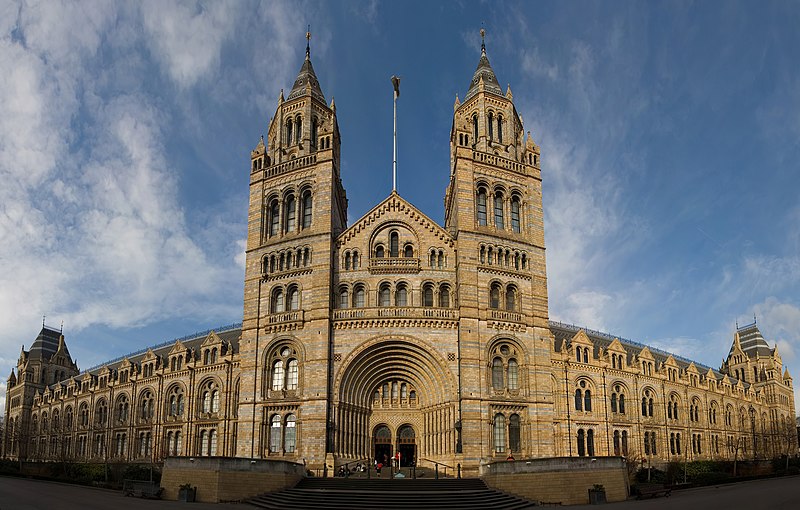
On Wednesday we went to the Natural History Museum. I was tremendously excited about this visit, partly because I recently read Bill Bryson's A Short History of Everything - a most accessible and fun book on natural history - which contained the following passage about the Natural History Museum in London:
How can that not capture your imagination? Just think of all the rare artifacts at the museum that have passed through the hands of exceptionally brainy people and all the knowledge that has been extracted. Think of the vast extent of the British Empire and their unique position to form an expansive collection for all their museums, including the Natural History Museum.

At the museum, we first attended their temporary Darwin exhibition (another link), which was wonderful. It told the tale of Charles Darwin's life, from his invitation to join the HMS Beagle on a voyage around the world as its naturalist, to his aha! moment stemming largely from observations on the Galapagos Islands, to the years after he finally published his theory of evolution through natural selection in On the Origin of Species in 1859.
 I have two favorite anecdotes about Darwin from the exhibit. The first was that he liked to "sample" (cook and eat) many of the animals he encountered on his travels. The second anecdote is from an encounter he had with gauchos in South America, who took him hunting for lesser rheas. The gauchos hunted rheas using bolas (two balls attached with a cord). When Darwin tried, he got his bola wrapped around the legs of his own horse. He wrote in a letter, "The Gauchos roared with laughter; they cried they had seen every sort of animal caught, but had never before seen a man caught by himself."
If you haven't been to the UK (or visited since 2000), you might also be interested to know that Darwin's likeness now adorns the £10 note.
 Matt riding the escalator through Planet Earth to the Volcano Exhibit
As for the rest of the museum, we looked at the exhibits on birds, dinosaurs, primates, geophysics, and minerals. We also visited The Vault, a display of rare (and often historically interesting) specimens of "gems, crystals, metals, and meteorites." The museum was great and I hope one day I can go back and spend more time there.
The Natural History Museum contains some seventy million objects from every realm of life and every corner of the planet, with another hundred thousand or so added to the collections each year, but it is really only behind the scenes that you get a sense of what a treasure house this is. In cupboards and cabinets and long rooms full of close-packed shelves are kept tens of thousands of pickled animals in bottles, millions of insects pinned to squares of card, drawers of shiny molluscs, bones of dinosaurs, skulls of early humans, endless folders of neatly pressed plants. ... The spirit room alone holds 15 miles of shelving containing jar upon jar of animals preserved in methylated spirit.
Back here are specimens collected by Joseph Banks in Australia, Alexander von Humboldt in Amazonia, and Darwin on the Beagle voyage - and much else that is either very rare or historically important or both.
Back here are specimens collected by Joseph Banks in Australia, Alexander von Humboldt in Amazonia, and Darwin on the Beagle voyage - and much else that is either very rare or historically important or both.
How can that not capture your imagination? Just think of all the rare artifacts at the museum that have passed through the hands of exceptionally brainy people and all the knowledge that has been extracted. Think of the vast extent of the British Empire and their unique position to form an expansive collection for all their museums, including the Natural History Museum.
At the museum, we first attended their temporary Darwin exhibition (another link), which was wonderful. It told the tale of Charles Darwin's life, from his invitation to join the HMS Beagle on a voyage around the world as its naturalist, to his aha! moment stemming largely from observations on the Galapagos Islands, to the years after he finally published his theory of evolution through natural selection in On the Origin of Species in 1859.
 I have two favorite anecdotes about Darwin from the exhibit. The first was that he liked to "sample" (cook and eat) many of the animals he encountered on his travels. The second anecdote is from an encounter he had with gauchos in South America, who took him hunting for lesser rheas. The gauchos hunted rheas using bolas (two balls attached with a cord). When Darwin tried, he got his bola wrapped around the legs of his own horse. He wrote in a letter, "The Gauchos roared with laughter; they cried they had seen every sort of animal caught, but had never before seen a man caught by himself."
If you haven't been to the UK (or visited since 2000), you might also be interested to know that Darwin's likeness now adorns the £10 note.
 Matt riding the escalator through Planet Earth to the Volcano Exhibit
London Eye
 After walking along the South Bank, we queued-up for a trip in the London Eye. The London Eye was opened in March 2000, as a celebration of the new millennium and a modern Britain. It was designed by David Marks and Julia Barfield, a husband and wife architect team.
There are 32 capsules on the wheel - one for each borough of London. Each capsule can hold 25 people; that's 800 people per revolution. The Eye loads and unloads while still moving and each flight last about 30 minutes. From the top of the Eye (135m tall), on a clear day, you can see Windsor Castle, some 40 km away. For more information about the construction of the Eye and other fun facts visit here.
Here are some of our photos of the Eye (since we chose to ride the eye at night and tripods are not allowed we do not have any pictures of the amazing views from capsule):


South Bank Walk
After Gallivanting through Greenwich, we hopped on a bus back to Tower Bridge to begin a walk down the South Bank of the Thames River. Here are the photos from our walk down the Thames:
 Tower Bridge
 Tower of London
 City Hall
 View of Downtown London from across the Thames River
 HMS Belfast
 Old Billingsgate Market
 Southwark Cathedral, where John Harvard was baptized
 Shakespeare's Globe
 We popped into the Royal National Theater for one of their daily free concerts. The concert of the day was by a jazz group called the Christian Brewer Trio.
 Golden Jubilee Bridge (AKA Wobbly Bridge)
 London Eye and the London Aquarium
 Big Ben & Parliament Buildings
Sunday, January 4, 2009
Gallivanting Around Greenwich
 On Tuesday morning we headed down to the Waterloo Pier to catch a commuter boat down the Thames River to Greenwich. We started our walking tour at the currently covered-up and under-renovation Cutty Sark tea-shipping vessel.
 The rest of our walking tour took us through the Maritime Greenwich UNESCO World Heritage Site. We walked through the Old Royal Naval College that was designed by Christopher Wren, who also designed the Old Royal Hospital in Chelsea. The wonderful example of baroque architecture is now home to the University of Greenwich and the Trinity College of Music.

 Our walk led us to the National Maritime Museum, which tells the story of British seafaring. My favorite exhibits in the museum were the photo gallery showing life on the British seashore, called Beside the Seaside, and the exhibit on the history of cruise ships and vacations.
 Next we walked through Greenwich Park to the Royal Observatory. Here we had the opportunity, along with tons of other like-minded tourists, to straddle the Prime Meridian and stand in both the Eastern and Western Hemipsheres at the same time.


 We also stuck around for the "ball dropping". Every day sine 1883 a red ball has dropped atop the Royal Observatory at 1pm to help boaters on the Thames set their clocks. This ball moves halfway up at 12:55pm, the rest of the way up at 12:58pm, and then drops down at 1:pm. The following video clip shows the dropping of the ball (sped-up, of course).
After setting our watches precisely, we headed back down through Greenwich Park to the Queen's House. Well, we might have stopped for a bit of Mexican food for lunch, but then we were on own way again. We took a quick walk through the Queen's House to see the Tulip Stairs (the first spiral staircase without a center support column), a beautiful marble floor, and the exhibit Turmoil and Tranquility (same wonderful paintings of seascapes, ships, and battles).
 After the Queen's House, we took the bus back to the Tower Bridge and began our walking tour of the South Bank...
 The view of downtown London from the Royal Observatory through the Old Royal Naval College.
Australia
Due to having pre-booked tickets, after a long afternoon nap, we trekked out to Portobello Road to the Electric Cinema for a showing of Australia. This wasn't just any movie theater. The seats were red leather, cushy arm chairs with foot stools and in between the chairs were tables with built in wine buckets. Since I was feeling yucky, we opted for cokes serves in glass bottles with staws and a large, gooey brownie. The experience even included an intermission (which was greatly needed in the middle of the over 2 and half hour movie). It was the perfect date night location.
Foxes and Hounds and Pigs! Oh my!
 No, we did not visit a British petting zoo, but rather took a pub walk through Chelsea. With promises of seeing celebrities' houses, visiting real English pubs, and a walk through the most exclusive borough of London, we set off with Claire, our guide from London Walks.
 Our first stop was the Fox & Hounds where we were told to drink only "real beer", AKA cask ales, or else risk banishment from the tour. Cask ales are served much warmer than lagers and other carbonated beers because they are served at cellar temperature (just imagine the beer in the summer months). The casks are stored in the cellar and the bartender siphons the beer into the pint glass up by pumping the tap. We joined the crowd and tried Young's Special and Bitter. The Fox & Hounds was a lovely Victorian pub, with wood paneled walls, decorated ceilings, and beautiful furnishings. As you entered the building, you stepped back into time.
After finishing our (half) pints, we walked through the heart of Chelsea. We passed the Old Royal Chelsea Hospital and the houses of:
- Paul Getty
- Eric Clapton
- Mick Jagger
- Brian Adams
- Keith Richards
- Richard Rogers
- And, the most important residence, of James Bond, 007. You can see the street sign from his street in the first photo. Unfortunately, he wasn't home.
 Our next stop was The Phoenix, a "tarted-up pub" according to the guide. It looked like the cross between a Starbucks and cosy wine bar inside. Fearing exile from the group, I tried an English cider instead of an ale. Fortunately, my Aspall Draught Suffolk Cyder was approved by the tour guide since it was made in England.
We finished the tour of Chelsea in The Pig's Ear, a pub across the street from Eric Clapton's house. Needing to get up early the next morning, we skipped the last drink and headed back to the hostel for the evening.
Wednesday, December 31, 2008
Arrival in London and The British Museum
 We arrived in London on Saturday morning via one of London's five (5!) international airports. After dropping our stuff at our hostel and risking mad cow disease with a hamburger lunch, we were off to the British Museum. The British Museum houses an awesome collection of artifacts from around the world. At right is the Great Court at the British Museum, which is beautiful, though when you visit in real life there are about 500 times as many people.
Among the many artifacts we saw were the Rosetta Stone (among an already fantastic collection of Egyptian artifacts) and the Elgin Marbles (a collection of Greek sculptures, many of which originated on the Parthenon). The Rosetta Stone, you probably remember, features the same passage written in three languages - two Egyptian scripts and Greek. The French discovered it in Egypt in 1799 after Napoleon's conquest the year before and it ended up in British hands shortly after they defeated the French in Alexandria in 1801. It has been on display at the British Museum since 1802. I'll leave the history of the Elgin Marbles to you, but do want to mention that there's a long-time, still-ongoing dispute between Britain and Greece about the Elgin Marbles. (The conclusion is this: the British have them, so that means they're winning.)
New Year's Eve in London
We'll be ringing in the New Year with the big fireworks show here in London tonight. Based on last year's show (see video below), I think it's going to be a blast!
Sunday, December 28, 2008
Britain and the USA
In honor of our trip to London, here's the opening credits to the HBO show "Little Britain USA," which discusses the many historical links between Britain and America.
Subscribe to:
Posts (Atom)


 Posts


