Showing posts with label Germany. Show all posts

Tuesday, April 28, 2009

Frisbee Outdoor Competition Day 2

On Sunday we trekked all the way to the University of Twente in Enschede - practically in Germany - for the second outdoor competition day in the Dutch Ultimate Frisbee League. Despite the long journey, we were fortunate to be far from the coast; weather in Enschede was beautiful and sunny with temperatures well above 70 °F. Meanwhile, the east of the country was easily 10-15 °F colder, overcast, and rainy.


View Larger Map


The University of Twente is basically in the middle of nowhere and hidden in thick tree cover. This makes the campus more picturesque than most Dutch universities. (TU Delft, for instance, looks vaguely like WW II just ended due to construction in the heart of campus, and TU Eindhoven has the distinct misfortune of being in Eindhoven.) On this day the most notable feature of the campus were the remnants of what must have been the biggest student party in the history of the universe - piles of beer bottles, people sleeping on the lawns, tents, half-dismantled stages, people walking with enormous backpacks, etc.

The event turned out to be an 18-hour overnight race from Nijmegen to Enschede, culminating in the massive campus party that we had just missed. We still had two frisbee games to brighten our day, though. We won our second game handily but lost our first to the other best team in our division. This ultimately kept us from advancing to a higher division next month. Even with the unfortunate loss, it's hard to complain about spending a nice day on soft grass in the sun.


More pictures on Flickr...

Tuesday, November 18, 2008

A Second Chance

There have been modern art museums in many of the cities we have visited, but frankly after the Pompidou Center experience we have been turned off modern art. However, since we had already paid for it and they had a few Andy Warhol pieces, we decided to visit Museum Ludwig.

The museum had a wonderful temporary exhibit of Gerhard Richter's work, the artist that designed the new stain-glass window in the Dom. In addition to the huge pieces of abstract work, they had a collection of 100, paired painted glasses pieces that were gorgeous. I would love to have one of those in my home.

In addition, the museum had a neat audio exhibit from Paul Plamper called A Radio Play in Space. It was a room filled with tables; on each tables was 2-5 speakers (symbolizing the number of people sitting at the table) and 2-5 chairs. When you entered the room you were greeted with the ambient noise of a restaurant; you could sit down at any of the tables and listen to the conversation. Then something happens; sometimes inside the restaurant, sometimes outside the restaurant and a collective hush falls over the room. It is social experiment in whether people will become involved in the event or become distant.

Other highlights of the museum included:
  • 20th century American Pop Art
  • A temporary exhibit for filmmaker Jonas Mekas
  • A wonderful graphic design exhibit of Thomas Bayrle
  • An exhibit titled "Looking for Mushrooms, Beat Poets, Hippies, Funk,and Minimal Art: Art and counter cultural in San Fransisco around 1968"
Maybe the art wasn't so modern, maybe it wasn't so out there, but we definitely enjoyed Museum Ludwig. So much so that we might venture into a modern art museum in the city we visit.

Euro REI

On Saturday night we stopped off at the German version of REI; we heard a rumor that they had a pool inside the store to demo equipment. We visited the flagship REI store in Denver, CO, where they have a track for testing mountain bikes and flume in the river for testing kayaks, and wanted to see how it compared.While the REI stores are definitely bigger, Globetrotter offered a few unique services. The pool in the center of the four story building was designed to test kayaks, canoes, and scuba equipment - a current could even be turned on at the touch of a button. The coolest features, however, were the rain and cold room. To try out their rain gear, you simply put it on and then stepped into the "rain room". Once in the room you can choose from simple rain or storm level rain. I wonder what they do with the jacket if you decide not to purchase it... Once your jacket has passed the rain test, you can demo it out in the "cold room" - literally a room with large ice block benches that is sub-zero degrees and has a wind option.

Oh, the money we could have spent in that store...

Monday, November 17, 2008

Two of a Kind

Koln has museum card for €20.50 for two adults and two children, for which you can get into all the city museums (10+ museums) and use the local transportation. Since we had already forked over the cash, we tried to visit as many of the museums as possible.

After the Roman museum, we visted the Wallraf-Richartz Museum - the local art museum. While it had a smattering of Van Goghs, Monets, and Reniors - the best part of the museum was its temporary exhibit: Kunstler Paare or Artist Couples. The exhibit show the works of artist couples side by side and showed how their work influenced each other. While many know about the relationship between Frida Kahlo and Diego Rivera, it also explored lesser know couples like Lee Krasner and Jackson Pollock, Sophie Taeuber-Arp and Hans Arp, and Georgia O'Keeffe and Alfred Stieglitz. For many of the couples, it was clear how they influenced each other - some made parallel works, some worked together on pieces, and some adopted each others' style. The exhibit was fascinating - great art, wonderful text, and exquisite curation.

When in Rome...

Side Portal of the Original City Gate, 50AD

Well, not exactly Rome, but rather a city built in Roman times. The main street through Koln dates back 2000 years and the city was officially recognized by the Roman Empire in 50AD (AKA - made apart of the Roman Empire).

To explore its Roman routes we visited the Roman-Germanic Museum. The highlights of the museum were a mosaic floor from a Roman merchant's house the museum was actually built around and the original arch from the city gate. Apparently if you are important enough, like one of the leaders of the G8 countries, you can enjoy a meal in the museum in the mosaic floor room. We ate our sandwiches outside, under the arch - way cooler! Mosaic FloorRoman Bust

Sunday, November 16, 2008

Cologne, Keulen, Koln

We rose extremely early for our train ride to Koln - like 4:20am early - the trade-off for dirt cheap train tickets. Due to the early departure time, we had to ride around the country in order to get to Koln and over five hours later we emerge from the train station.

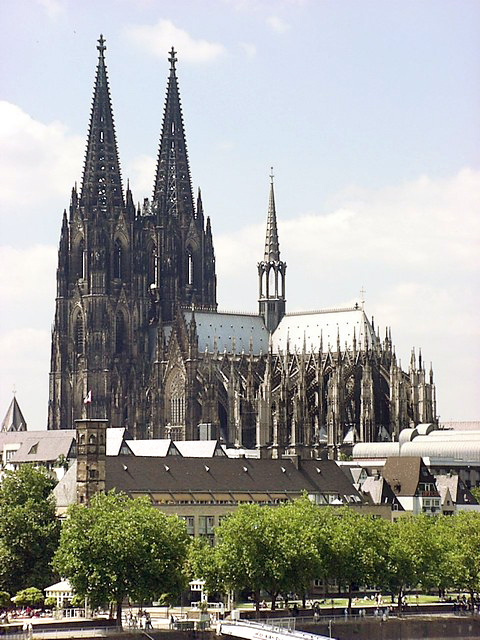
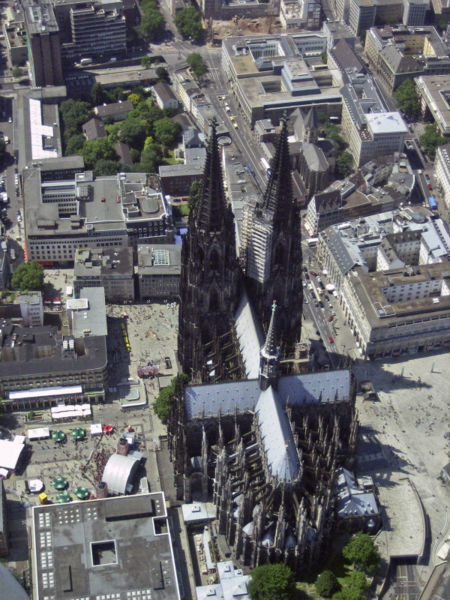
We were quickly jerked out of our half-opened eye state by the site of the Dom. It was ENORMOUS! We were amazed despite having seen TONS of huge churches lately.


Amazing Facts:
  • It was the world's tallest building until 1884 (when the Washington Monument was built)
  • It has the world's second tallest church Spires
  • It is a UNESCO World Heritage Site for "exceptional work of human creative genius"
  • Has the largest facade of any church in the world
  • It has stained glass from the Medieval time period, the Renaissance, post WWII, and a window designed by Gerhard Richter in 2007
  • Houses the largest reliquary in the Western world - the bones of the three wise men
  • Has the largest free-swinging bell in the world

Wednesday, November 12, 2008

Quirky Berlin

Berlin has the museums, the memorials, the historic site, and all the other usual tourist fair. But what lets you know you are in Berlin are its endearing quirks. Two of our favorites were:
  • Pedestrian lights left over from the Cold War
  • An above ground system of brightly painted water pipes, due to the never ending construction and high water table

A little bit of home...

Since the cuisine in Berlin is known for is anything but German, we headed towards a little bit of home for lunch.Never has a toasted sourdough roll with smoked ham, salamis, melted cheddar, mozzarella, and parmesan cheeses, black olives, red onions, lettuce, tomatoes, and mustard ever tasted so good! And the Coke even came out of a soda fountain machine! No ice - hey, something had to tell us we were still in Europe.Mmmm! Mmmm!

Tuesday, November 11, 2008

"Tear down this wall!"

We didn't make it to the Museum of the Wall at Checkpoint Charlie until the second day we were in Berlin, but all over the city the scar left by the wall is evident. A double cobblestone line in the street marks the path of the former wall throughout the city. The wall stood for 28 years and 1 day - a symbol of the Iron Curtain and the literal dividing point between Communism and Democracy. The wall built in 1961 not only separated governments and countries but split families apart, tore people from their jobs, and separated friends.

The Museum of the Wall at Checkpoint Charlie was established in 1962 as a nonviolent protest to the wall. It was built right next the border and contained exhibits on people escaping East Germany. It was a thumb at the Communists right outside their own backyard.Today the museum is a hodge podge of escape tales, facts about the wall, stories of life with the wall, and a chronicle of the USSR. Frankly, the museum is an overload of unorganized information; although bits and pieces are interesting, much of it has nothing to do with the wall. The highlights of the museum are cars altered for escapes, flight contraptions used to fly over the wall, and videos of people tearing down the wall.

The other place in town to experience the wall is the East Side Gallery - a mile long stretch of the wall that is frequently painted by invited artists. Unfortunately, between paintings the wall is heavily graffitied, but they just white-wash it and invite new artist to paint again.

Brandenburg Gate

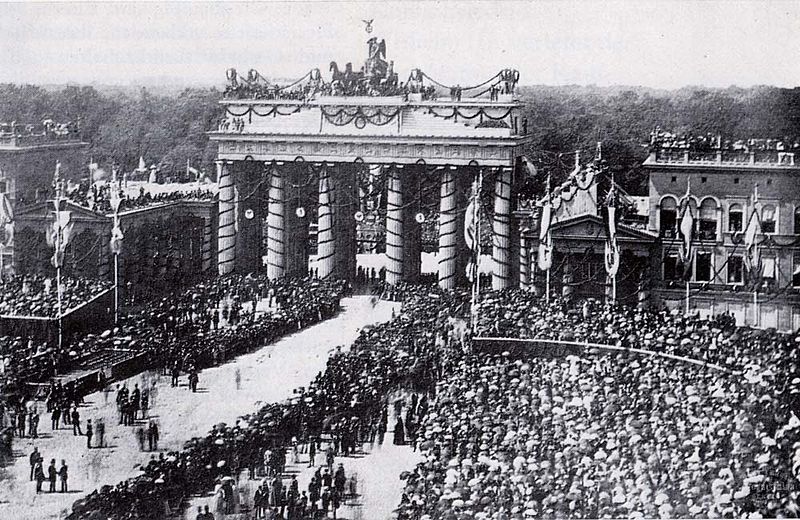
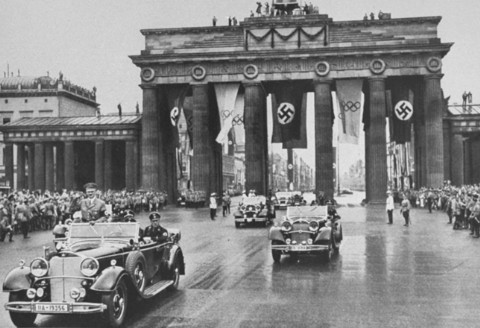
The Brandenburg Gate has been a symbol of Berlin since it was built in 1791. The gate has been a emblem of Prussian Berlin, the site of Nazi Rallies, a symbol of a divided Berlin, the place of reunification, and, now, a gate into a revitalized eastern Berlin.

The gate was built as just one of fourteen gates to the city. It was designed after the Propylaea Gate in Athens by Carl Gotthard Langhans. The statue on top is of the Goddess of Peace and her four horse chariot.


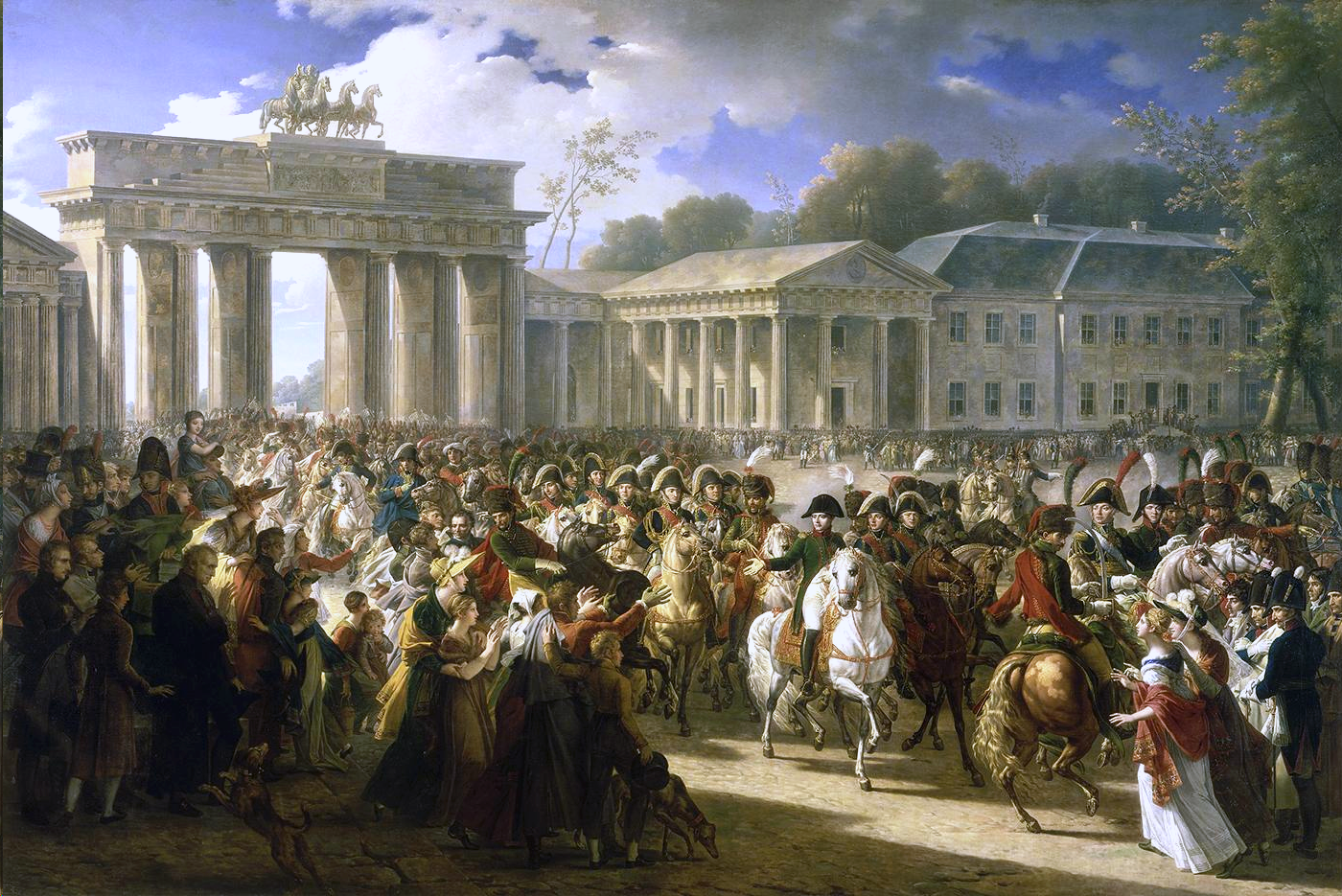
After the defeat by the Frenach, Napoleon took statue and placed it in the Louvre.

In 1813 the Goddess became the Goddess of Victory as the Prussians took the statue back and returned it to the top of the gate.

The gate become an representation of Nazi Germany during the Berlin Olympics in 1936 when the gate was draped in Nazi banners.

Destroyed by bombing, the gate laid in ruins after WWII.

After the war the east and west together restored the gate. It was used by cars and pedestrians until the Berlin Wall was erected in 1961, when it became part of "no man's land". When JFK gave his "I am a Berliner" speech at the gate in 1963 the Soviets hung banners from the gate so he could not see into East Germany. It remained unused until the fall of the Berlin Wall.

In July 1987 speech at Brandenburg Gate, Ronald Reagan spoke to the people and demanded:

"General Secretary Gorbachev, if you seek peace, if you seek prosperity for the Soviet Union and Eastern Europe, if you seek liberalization: Come here to this gate! Mr. Gorbachev, open this gate! Mr. Gorbachev, tear down this wall!"

Two and half years later they did just that. The gate became a symbol of reunification on November 9, 1989 when 100s of Berliners packed the gate and surrounding squares in celebration. The Bandenburg Gate was officially reopened on December 22, 1989 when the West German Chancellor and the East German Prime Minister met under the gate

Once again a US President spoke at the gate, when Bill Clinton came to Germany to speak about post-cold war peace and said:

"We stand together where Europe's heart was cut in half and we celebrate unity."


The Brandenburg Gate has become one of the most recognized symbols of Berlin and of Germany - reminding all who walk through her of the struggles and events of the past, present, and future. You can't help but marvel at the struggles of freedom the gate has seen.

Holocaust Memorials

Outside of the Reichstag Building is a memorial to the 96 politicians who were murdered because their beliefs did not align with Hitler and the Nazi Party. They were members of the ill-fated Wiemar Republic, the weak post WWI attempt at German democracy. Most of the 96 politicians were members of the Communist or Socialist party; they were murdered in concentration camps.

Each slab of the memorial represents one man; on each slab is the man's name, his party, his date of birth, and the date and location of death.


The next stop was the Memorial to the Murdered Jews of Europe. This Holocaust memorial was completed in 2005 and is this first formal, government sponsored Holocaust memorial. Designed by Peter Eisenman, the 2711 concrete slabs vary in height and are arranged on an even surface. The interpretation of the memorial is left up to the visitor. Some view it as a symbolic cemetery; some think of it as a representation of how European Culture was changed. However, I doubt that it was ever intended for people to use it as a bus stop bench, a place to sit and talk on cell phones, or a playground for climbing all over.


Underneath the memorial is an information center containing 6 exhibits about the Holocaust.
  1. Introduction - 12 years of the Nazis' extermination policy shown through text and pictures.
  2. Room of Dimensions - written personal accounts of Jewish men and women - including postcards and letters thrown off trains on the way to extermination camps. This room also included the breakdown of murder Jews by country.
  3. Room of Families- stories, pictures, letters, and writings of Jewish families and how the Holocaust affected them.
  4. Room of Names - biographies of murdered Jews read aloud with their name , year of birth, and year of death projected on the walls. It would take over 6 and a half years to read through the entire database - names and stories are still being added.
  5. Room of Sites - information on 220 sites of genocide.
  6. The Holocaust Memorials.Database
While the spot for the memorial was chosen based on where there was room for lots of people to experience it, it lies within a historical area. The land was available here because the memorial is built on land that was once covered by the Berlin Wall. During the building of the memorial, Joseph Goebbels' (the leader of the Nazi propaganda machine) bunker was uncovered in the northwest corner of the memorial. Additionally, Hitler's bunker is less than 200 yards away. Both sites have been left buried so they do not turn into shrines for the neo-Nazis.

Since the focus of this memorial is the Jewish victims, the government has promised to build memorials to the other victims of the Holocaust as well. Behind the Memorial to the Murdered Jews of Europe is small memorial to the homosexual victims of the Holocaust; however, it was not government sponsored.

Monday, November 10, 2008

Berlin

Berlin is a modern city growing out of scars and wounds of the past, some self inflicted, some brought on by others, but most incurred through the World Wars and their aftermath. Our site seeing in Berlin was not focused on famous paintings or world class museums, but rather to visit the sites and memorials that explain how Berlin got to where it is today.

Paris has the Eiffel Tower. London has Big Ben. New York has the Statue of Liberty. Berlin cannot be represented in building and building cannot represent Berlin. Some might say the Berlin Wall, but that is gone now and only bits remain memorialized. Famous Landmarks of the city from before WWII, like the Kaiser Wilhelm Church, were destroyed in the bombings. Even the Victory Column was moved before WWII and now represents more than the Prussian defeat of France. Brandenburg Gate only represents a sliver of the city's history and the Reichstag Building is no longer the Reichstag and has a new roof. Potsdamer Platz is only a decade old and represents more corporation that city.

We spent the weekend exploring the city - it's past and present.

Red Thread Tour

On my second day in Hannover I took the city's Red Thread Tour. The tour was a 5 km walk through the city following a red line painted on the sidewalk that showcased 35+ important sites in the city. While most of the sites would not have even made the guidebook of a larger city, I nevertheless decided to see what Hannover had to offer.

Some highlights of the tour:
A remnant of the old city wall - dating from 1337

A church destroyed in the 1943 air raid and currently a memorial to the victims of war and violence; a memorial service takes place here every August 6th to remember the victims of the bombing of Hiroshima.

New Town Hall - the archer's arrow points directly at the Lord Mayor's office

Buxom Girls - statues by Niki de Saint Phakke, an honorary citizen of Hannover

The oldest family house in Hannover - dating from 1566

And after the history tour, it was time to check out the shopping and the first mall we've seen since leave Gainesville...

Lions and Tigers and Bears! Oh My!

Since our trip to Germany was centered around a conference where Matt was presenting a poster, we spent the middle part of the week in Hannover. Most guidebooks skip over this town as it is mostly a convention and shopping town. Since it was low on the typical tourist sites (churches, art museums, and memorials), I decided Hannover called for a visit to the zoo!

The brochures touted it as the number one zoo in Europe and it did not disappoint. The complex was as themed as Disney, as educational as a museum, and as clean as a hospital. I easily spent the day lost in their world of animals as there were animal feedings every half hour, hourly shows, plenty of playgrounds, many eateries, tons of animals and exhibits, and a boat ride.

The zoo showcases a major difference between play areas for kids in the US and in Europe. At home things are designed so no one can get sued, here things are designed for kids to explore. Between every exhibit there was the traditional paved pathway for adults and strollers, but the second pathway was where the fun was. It criss-crossed back and forth with the paved pathway so parents could keep an eye on their kids, but it was a "wobbly trail". A trail of bridges, rope courses, things to jump on and off, balance beams, and anything else you can imagine for a kid to climb on, over, around, and in while making their way from point A to point B via point M. In addition to these wonderful paths there was an awesome play area for kids to really run loose. It feature a river system controlled by the kids and had wonderful fixtures like a trampoline hut, a mini rock wall, and multiple kinds of swings.

Yes - I played on it all by myself and had a ball!

If you are ever in Hannover at the Zoo, make sure not to miss out on:
  • The adorable Giraffes and their wobbly legs

  • The larger than life Rosa Pelicans, who if you are patient will let you pet them
The only reason I headed home that day was because it started to rain...or else I might still be hanging out with the giraffes!