Showing posts with label Architecture. Show all posts

Wednesday, December 10, 2008

Prague Take Two

Day two in Prague started very early in the morning- 4:30 am early. Not because we wanted to see the Charles Bridge before it filled with tourists, see the sun come up over the castle, or visit any early morning fish market, but rather because we had the worst hostel roommates ever. I know people are going to stay up later or wake-up earlier than us in every place we go and do some strange things, but there are some common rules of hostel etiquette and they broke every single on of them.

Rising for the second time just past 8, we headed out to explore the architecture of Prague. Having become enamored with Art Nouveau architecture last week in Brussels, I was excited to see countless Art Nouveau buildings in Prague. The Municipal Building and Hotel Paris are two wonderful, classic examples of Art Nouveau; everything in the buildings was designed to be practical, beautiful, and harmonious. The stained-glass windows are definitely one of my favorite features. I imagine the €150 a night stay in the Hotel Paris would be worth the splurge just to stay in the glamor of the building.Next we went to visit a building of the extreme opposite, a cubist building. Gone where the curved lines, metal & glass structures, and floral motifs - the building was an example of geometry and minimalism.

Prague has done a wonderful job of blending their immensely varied architecture, so that no building seems out of place or draws attention to itself. After that, it was over the river and down the street to the wonderful lunch spot we found the day before.

Monday, December 8, 2008

Castle

After checking into our hostel, we headed off to Prague's main site - the Pražský hrad. It might just be the biggest ancient castle and seemed more like a walled-city. The interior of many of the buildings have beautiful, ornate Gothic vaulting and ribbing, including the Old Royal Palace.Apparently it used to be acceptable to sentence someone to being throw out the window, or defenestration, in Prague in the Middle Ages. The Old Royal Palace is where the Second Defenestration of Prague occurred, although the councilors' lives where saved when they landed on a pile of dung.

While the castle buildings varied widely in their architectural styles, most of the building were early, middle, or late Gothic in origin. Contrasting this was the St. George Basilica, which is probably the best example of preserved example of Romanesque architecture in Prague. Golden Lane provided a view into 16th century cottages , originally built to house the sharp shooters of the castle guards. Over the years the cottages have also been lived in by goldsmiths, squatters, and artists. Kafka even lived here for a short period of time (in #22). Today they house shops hawking tourists souvenirs. The view of the castle at night from the Charles Bridge is spectacular.

Prague

On Friday we arrived in Prague, the city of a 1000 spires, where the streets are paved with gold. Err...umm...cobblestones - of all shapes, sizes, designs, and dimensions. What's a few blisters and sore feet, when the travel guides promise the best beer in Europe, cheap food, and a great introduction to Eastern Europe?Prague did not disappoint - and we will share how we ate our way through the capital of the Czech Republic, discovered €5 operas, fell in love with Moorish inspired architecture, and found the smoothest (and cheapest) beer in Europe.

Wednesday, December 3, 2008

Art Nouveau & Comics

Brussels is home to two often forgotten arts: Art Nouveau and comics.

Brussels is the capital of Art Nouveau, with the first two Art Nouveau buildings being built here in 1893 by Victor Horta and Paul Hanker. The movement of Art Nouveau, the merging of applied art and fine art, sought to combine function and art into every part of life: architecture, furniture, textiles, household appliances, art, etc. It is recognizable by the curved lines, stained-glass windows, flora motifs, and metal & glass structures. My favorite characteristic of Art Nouveau are the Tiffany like stained-glass windows, made famous by Louis Comfort Tiffany, in so many of the buildings in Brussels.
We visited the Old England building- a classic example of Art Nouveau architecture- which houses the Musical Instrument Museum. Even though there are over 1200 Art Nouveau building in Brussels very few of them offer the public an opportunity to see the interiors and the Old England building provides one of these rare glimpses into the inside of the unique buildings - making a visit to museum worthwhile just to see the inside. While there was very little information provided in the museum in English, the music on display speaks internationally. I particularly enjoyed the room where you could play and experiment with different musical instruments.


One of the most famous Art Nouveau buildings is the Waucquez Textile Shop, designed by Victor Horta and part of a four building group that has been declared a UNESCO World Heritage Site. Today the building is the home of the Belgian Comic Strip Center. Don't let the English website fool you - all the comics and almost all of the commentary is in French or Dutch. Do as Rick Steves recommends - visit the lobby, take photos with the comic book characters, and save your €5 entry fee to buy a beer later.
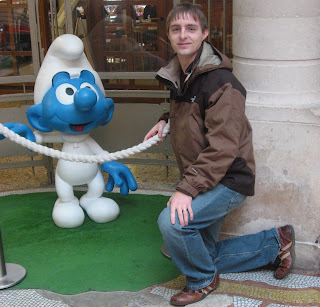


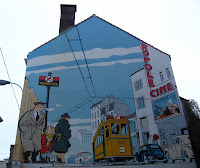
Brussels' love affair with comics doesn't end with the museum, or even the countless comic book shops around the city. They took it to a whole new level. There are 35 + sites throughout city where you can find larger than life comic character statues and murals - and more are added every year. We visited as many of them as made sense with our other site seeing - hopefully we will be back in Brussels before this adventure is over the see the rest, or at least add to our list.



Monday, October 6, 2008

Step inside a Piet Mondian Painting...

Step inside a Piet Mondrian painting and enter the Rietveld Schroder House, a house built entirely in the "De Stijl" style or neoplasticism. Artists of this movement aimed to simplify everything to vertical and horizontal lines and used only primary colors along with white, black, and grey. The house provides a large contrast with the traditional style Dutch canal homes with which it shares a wall.

The house was designed by Gerritt Rietveld and Truus Schroder. The owner of the house, Truus Schroder, is considered one of the architects because the house is a collaboration between the two - his artistic style and her functional designs. It was built in 1924 and was lived in by Ms. Schroder until her death in 1985.


The house was architecturally and artistically amazing. The furniture inside was even designed by the architects and follows in the De Stijl style. The house was designed with walls that could be removed during the day to allow for a more social, open atmosphere in the house. So at night there are 3 bedrooms and an office, but during the day the walls all slide back (much like a temporary classroom) and a large living space is created. I wish I could show you more pictures of the interior of the house, but it is protected by copyright and we were not allowed to take photos. A small clip of the house is available here.

This house is a world heritage site, considered "a masterpiece of human creative ability" and "an important and unique icon of western architectural history" by UNESCO. There are 7 UNESCO sites in the Netherlands (only 6 on the mainland - the 7th is in Curacao) and we hope to visit them all during our stay here. In comparison, the United States only has 20 sites.